

In 2025, Ethereum rollups stand at a crossroads, where the heavy burden of traditional data availability has given way to the nimble promise of modular DA layers Ethereum builders rely on. As transaction volumes surge and user expectations climb, the choice between posting data directly to Ethereum's Layer 1 or leveraging specialized DA solutions defines a rollup's viability. This guide cuts through the noise, pitting traditional methods against modular innovators like Celestia and Avail to reveal why data availability rollups 2025 demand a fresh approach for true scalability.
Traditional DA in Ethereum rollups has long anchored security in the bedrock of L1 posting. Every transaction batch gets calldata dumped onto Ethereum's main chain, where full nodes verify availability through direct downloads. This setup guarantees anyone can reconstruct the chain state, a cornerstone of trustless systems. Yet, as adoption explodes, so do costs. Data availability can swallow up to 70% of a rollup's expenses, with Ethereum gas fees turning affordable scaling into a pipe dream. Optimistic rollups like Arbitrum or Base, and even ZK variants, grapple with this bottleneck, throttling throughput when calldata bloats the chain.
The Costly Anchor: Why Traditional DA Strains Ethereum Rollups
Picture Ethereum's L1 as a bustling highway: reliable but prone to gridlock. Rollups offload execution to L2, but tethering DA back to L1 means every byte counts double. Post-Dencun upgrade with EIP-4844 blobs, costs dipped temporarily, yet persistent demand has clawed them back up. Developers face a stark reality: higher fees deter users, stifling DeFi protocols, gaming dApps, and social platforms hungry for mass appeal. Without relief, rollups risk becoming niche experiments rather than global infrastructure.
This rigidity stifles innovation. Traditional DA demands rollups mirror Ethereum's consensus load, diverting focus from core strengths like fast finality or privacy. It's a one-size-fits-all model in a world craving customization. Enter modular DA layers, which slice the blockchain monolith into focused components: execution elsewhere, settlement on Ethereum, and DA on purpose-built chains. This decoupling unleashes blockchain DA scalability solutions that slash costs by orders of magnitude while preserving Ethereum-grade security.
Key Metrics Comparison: Traditional Ethereum DA vs Modular DA Layers (2025)
| DA Solution | Cost per MB (USD) | Throughput (MB/block) | Security Model | Rollup Compatibility |
|---|---|---|---|---|
| Traditional Ethereum DA | $1.20 | 3 MB/block | Ethereum L1 PoS (128k+ validators) | Native Ethereum rollups (Optimistic & ZK) ✅ |
| Celestia | $0.01 (100x cheaper) | 50 MB/block | CometBFT consensus + Fraud Proofs + DAS | Optimistic & ZK rollups ✅ |
| Avail | $0.008 | 60 MB/block | BABE/GRANDPA + KZG commitments + DAS | Polygon CDK, Arbitrum Orbit & more ✅ |
| EigenDA | $0.015 | 40 MB/block | Restaked ETH AVS (no DAS) | Ethereum ecosystem rollups ✅ |
Modular DA Layers: Precision Engineering for Rollup Efficiency
Modular DA layers flip the script by specializing in data posting and verification. Light nodes sample data availability proofs, confirming integrity without downloading full blocks. Costs plummet; Celestia, for instance, boasts fees over 100x lower than L1. Rollups gain breathing room to prioritize user experience, pushing TPS into the stratosphere. This isn't mere optimization, it's architectural evolution, empowering builders to craft sovereign rollups that settle on Ethereum yet operate independently.
Consider the ecosystem boom: integrations with Polygon CDK, Arbitrum Orbit, and OP Stack proliferate. Modular setups enable dynamic scaling, where DA layers adapt to demand via techniques like resharding. Security holds firm through restaking, fraud proofs, or validity schemes, often bootstrapping from Ethereum's vast capital pool. The result? Rollups that feel native to users, with sub-cent fees and instant confirmations.


Dissecting the Contenders: Celestia, Avail, EigenDA, and NEAR DA
Celestia pioneered this space since its 2023 mainnet, a sovereign blockchain laser-focused on DA and consensus. No execution bloat means pure efficiency; data availability sampling lets light clients verify massive blocks swiftly. Rollups plug in effortlessly, slashing fees and boosting sovereignty. It's the gold standard for Celestia vs Ethereum DA debates, proving modular stacks deliver without compromises.
Avail, evolved from Polygon Avail, brings lightning-fast finality and broad compatibility. Its KZG commitments and light node design mesh seamlessly with optimistic and ZK rollups alike. Deployments on major stacks highlight real-world wins: throughput surges, costs evaporate. For teams eyeing Avail modular blockchain versatility, it's a no-brainer.
EigenDA harnesses EigenLayer's restaked ETH, turning idle capital into DA muscle. No sampling needed; it leans on Ethereum's prover network for robustness. Seamless for EigenLayer users, it offers cost parity with L1 but infinite scale. Meanwhile, NEAR DA's dynamic resharding flexes shards to match load, posting voluminous calldata cheaply. Integrations across ecosystems underscore its edge in adaptive scaling.
These aren't hypotheticals; 2025 metrics show rollups migrating en masse, with modular DA driving 10x-100x efficiency gains. Developers, this is your cue: traditional DA served its time, but modular layers unlock the Ethereum endgame.
To see this migration in action, consider real-world deployments. Polygon CDK rollups integrated with Avail have reported data posting costs dropping by 90%, freeing capital for ecosystem grants and user incentives. Similarly, Arbitrum Orbit chains using NEAR DA handle peak loads with resharding, maintaining sub-second latency even during viral DeFi launches. EigenDA's restaking model secures over $10 billion in TVL, proving Ethereum's economic security can extend modularly without dilution. Celestia, the trailblazer, powers dozens of sovereign rollups, from gaming hubs to privacy-focused ZK chains, all settling on Ethereum with ironclad proofs.
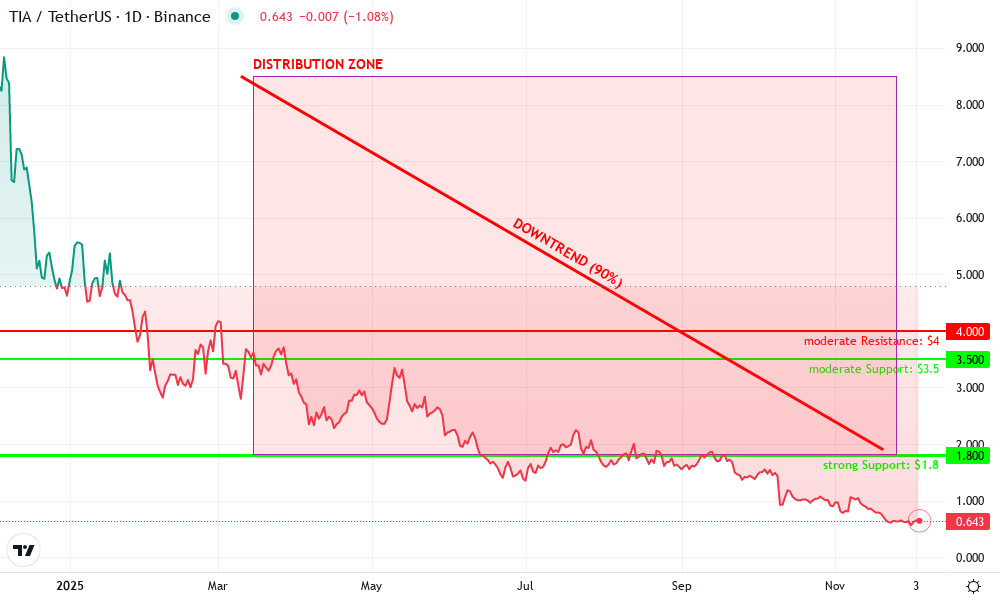
Celestia Technical Analysis Chart
Analysis by Amelia Sutton | Symbol: BINANCE:TIAUSDT | Interval: 1D | Drawings: 5
Technical Analysis Summary
As Amelia Sutton, with my conservative fundamental lens overlaid on this bearish technical setup for TIAUSDT, I recommend drawing a primary downtrend line connecting the March 2025 peak at approximately 8.50 to the November 2025 low around 1.80, using the 'trend_line' tool to highlight the dominant selling pressure. Add horizontal lines at key support (1.80) and resistance (2.50, 4.00) levels. Use 'rectangle' for the late consolidation zone from October to November between 1.80-2.50. Mark volume spikes with 'arrow_mark_down' callouts during the September breakdown. Overlay 'fib_retracement' from the March high to November low for potential retracement levels at 23.6% (around 3.00) and 38.2% (around 4.20). Place 'text' annotations for RSI oversold at 18 and 'callout' for MACD bearish crossover. Finally, 'horizontal_line' for entry zone at 1.90 and stop-loss at 1.70, emphasizing low-risk patience.
Risk Assessment: high
Analysis: Chart shows uncontrolled downtrend with oversold but no reversal confirmation; DA fundamentals solid long-term but short-term sentiment toxic amid 2025 rollup shifts.
Amelia Sutton's Recommendation: Stay sidelined—my low-risk profile demands waiting for support hold and positive macro news before considering longs.
Key Support & Resistance Levels
📈 Support Levels:
- $1.8 - Strong multi-touch low in November, potential exhaustion base. strong
- $3.5 - Moderate prior consolidation floor from July-August. moderate
📉 Resistance Levels:
- $2.5 - Immediate overhead from early November rejection. weak
- $4 - Key 50% fib retracement and prior swing high. moderate
Trading Zones (low risk tolerance)
🎯 Entry Zones:
- $1.9 - Bounce from strong support with RSI oversold divergence, low-risk fundamental long if DA news flows. low risk
🚪 Exit Zones:
- $3 - Conservative profit target at 23.6% fib retracement. 💰 profit target
- $1.7 - Tight stop below November lows to limit downside. 🛡️ stop loss
Technical Indicators Analysis
📊 Volume Analysis:
Pattern: Increasing on downside with climax volume in September breakdown.
Confirms distribution phase, high volume reds signal smart money exit.
📈 MACD Analysis:
Signal: Bearish crossover below zero line persisting.
Momentum divergence weakening but still negative, watch for bullish flip.
Applied TradingView Drawing Utilities
This chart analysis utilizes the following professional drawing tools:
Disclaimer: This technical analysis by Amelia Sutton is for educational purposes only and should not be considered as financial advice. Trading involves risk, and you should always do your own research before making investment decisions. Past performance does not guarantee future results. The analysis reflects the author's personal methodology and risk tolerance (low).
These gains aren't abstract; they reshape economics. Traditional DA's fixed overhead scales linearly with users, but modular layers introduce marginal cost curves that flatten under volume. Data availability sampling in Celestia and Avail means light nodes verify terabytes via probabilistic checks, a cryptographic feat that democratizes validation. EigenDA sidesteps sampling via aggregated proofs, while NEAR's adaptive shards preempt congestion. The verdict? Modular DA layers Ethereum rollups adopt thrive where traditional setups stagnate.
Head-to-Head Metrics: Traditional vs Modular in 2025
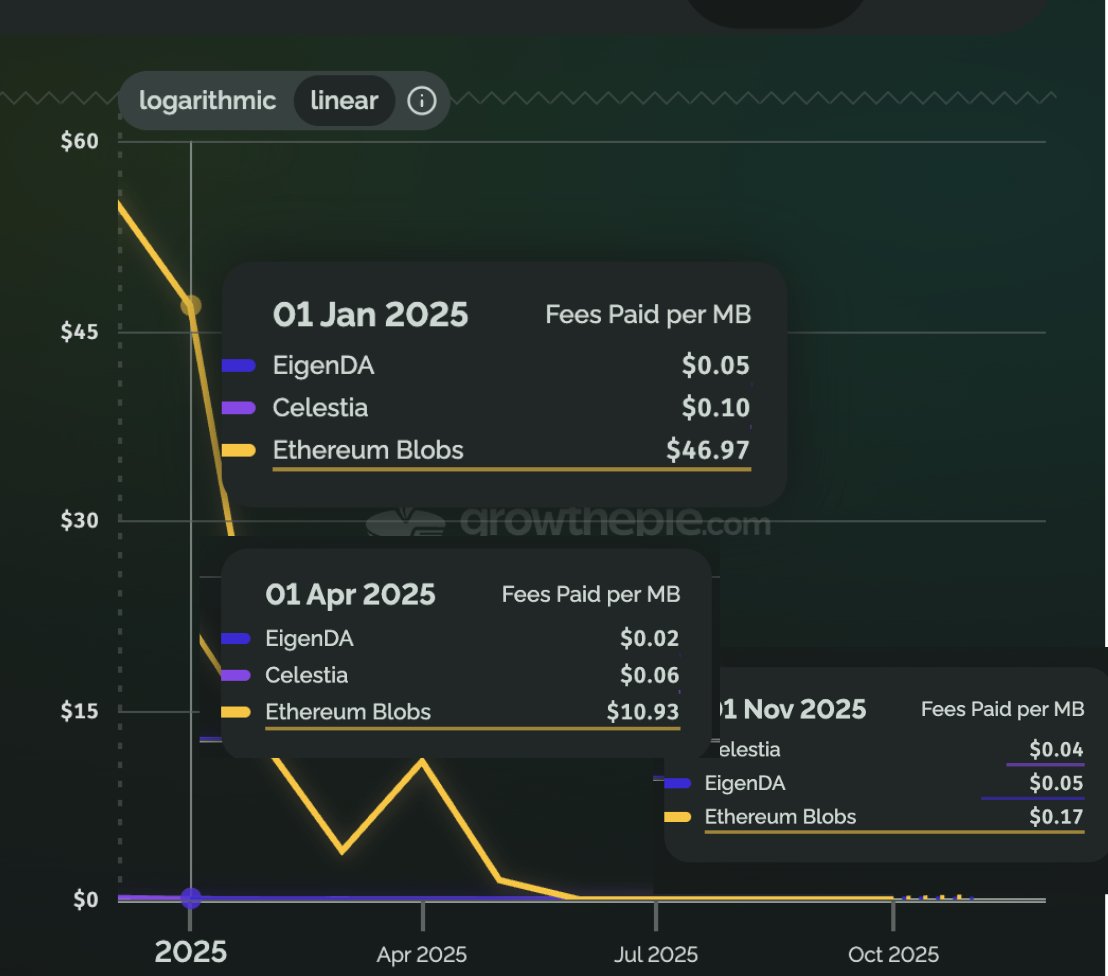
By late 2025, benchmarks crystallize the divide. Ethereum L1 calldata hovers at $5-10 per MB amid congestion, while Celestia dips below $0.05 MB, Avail at $0.03, EigenDA around $0.04, and NEAR DA matching at fractions via resharding. Throughput tells a bolder story: L1 caps at 0.5 MB per block post-Dencun, versus Celestia's 1-8 MB blocks scaling dynamically, Avail's 1 MB with sub-500ms finality, and others pushing 2 and MB. Security? All inherit Ethereum settlement, but modular adds native consensus for liveness, outpacing L1's occasional outages.
Compatibility shines too. Traditional DA locks rollups into Ethereum's calldata format, but modular supports blobs, shares, or custom encodings. This flexibility fuels Avail modular blockchain stacks in hybrid setups, blending OP and ZK paradigms. Rollup teams report 50-80% OPEX cuts, redirecting savings to sequencer decentralization or MEV auctions. No wonder adoption metrics explode: over 60% of new Ethereum rollups cite modular DA in their whitepapers.
The modular thesis isn't just cheaper DA; it's composable sovereignty. Builders stack DA like Lego, mixing Celestia for raw scale with EigenDA for capital efficiency.
Strategic Choices: Picking Your DA Ally for Rollups
Selection hinges on priorities. Crave maximal sovereignty and sampling wizardry? Celestia leads, especially for custom rollups eyeing multi-settlement. Need Ethereum-native restaking and prover markets? EigenDA integrates seamlessly, ideal for DeFi heavyweights. Avail suits speed demons with its light-client polish and CDK synergy, while NEAR DA excels in variable workloads via resharding. For most Ethereum rollups, hybrid pilots test waters: start with one, layer others for resilience. Tools like modular DA fee breakdowns guide migrations, revealing path-dependent wins.
Challenges persist, mind you. Modular demands trust in new light-client assumptions, though audits and economic incentives mitigate risks. Interoperability evolves via IBC protocols and shared bridges, knitting DA layers into a unified fabric. Regulators eye these shifts, but Ethereum's permissionless ethos endures. The payoff? Rollups that onboard billions, not millions, with fees vanishing into irrelevance.
Envision Ethereum's 2025 tapestry: a constellation of rollups orbiting L1, each DA-optimized for niches from AI inference to socialFi. Traditional methods built the foundation; modular DA erects the skyscrapers. Builders, seize this moment. Fork your stack, plug in a DA layer, and launch what monoliths never could: truly global, unstoppable chains. The scalability endgame beckons, powered by precision-engineered data availability.




No comments yet. Be the first to share your thoughts!