

In the rapidly evolving landscape of modular blockchains, builders face a pivotal choice: how to architect systems that scale without compromise. Data availability layers and LayerZero represent two cornerstone innovations, yet they tackle distinct challenges in the modular stack. While data availability layers like Celestia ensure transaction data is securely stored and verifiable, LayerZero powers seamless cross-chain messaging. Understanding their differences is crucial for developers crafting efficient, interoperable decentralized applications.
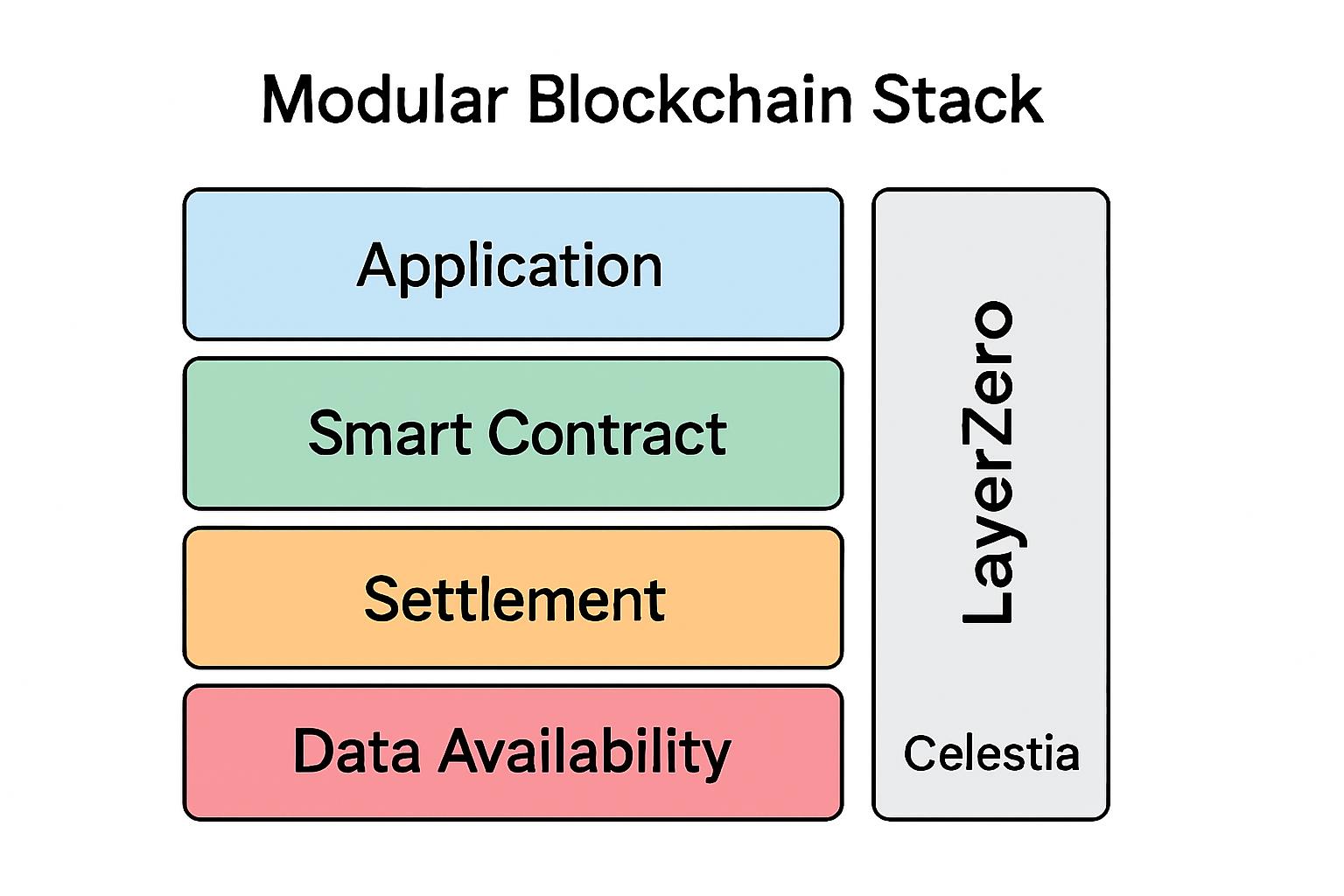
Modular architectures dismantle the monolithic blockchain model, separating consensus, execution, and data availability into specialized layers. This shift promises unprecedented scalability, with projections indicating DA layers will underpin 80% of Layer 2 activity by the end of 2025. For builders, this modularity means freedom to optimize each component, but it demands precision in selecting tools that align with project goals.
Mastering Data Availability Layers for Scalable Foundations
Data availability layers serve as the bedrock of modular blockchains, guaranteeing that transaction data remains accessible to all network participants without bloating the core chain. In essence, a DA layer stores blockchain data, enabling nodes to verify transactions efficiently. Celestia stands out as the frontrunner, leveraging namespaced blobs and data availability sampling to slash developer costs by approximately 95%. This eliminates data availability as a scaling bottleneck, allowing rollups and other rollups to post data cheaply while maintaining security.
Consider Celestia's approach: it operates as a minimal blockchain focused solely on data availability, decoupling it from execution and consensus. Developers benefit from predictable blob economics, making it ideal for L2 data availability solutions. Projects posting data to Celestia can build fully onchain applications at fractions of Ethereum's cost, fostering innovation in high-throughput environments. From my vantage in decentralized infrastructure, this specialization is a strategic masterstroke, positioning DA layers as indispensable for any builder eyeing long-term scalability.
Top DA Layers vs Monolithic Data Storage: Key Features Comparison
| Feature | Monolithic Data Storage | Celestia | Avail |
|---|---|---|---|
| Cost Reduction | ❌ High costs due to integrated data posting (e.g., full block data on L1) | ✅ ~95% cost drop for developers via blobs and dedicated DA | ✅ Significant reductions with efficient data posting and sampling |
| Sampling Efficiency | ❌ Requires full data download by all nodes | ✅ Data Availability Sampling (DAS) with namespaced blobs for light verification | ✅ DAS using KZG commitments for lightweight node participation |
| Rollup Support | ⚠️ Supported but expensive and bandwidth-intensive | ✅ Optimized for rollups - eliminates DA bottleneck, enables fully onchain apps | ✅ Strong support for rollups with modular data storage |
| Scalability | 📉 Core bottleneck limits throughput | 🚀 High throughput DA enables 80%+ L2 activity by 2025 | 🚀 Enhances modular scaling for execution layers |
| Economic Predictability | ❌ Variable gas fees tied to execution | ✅ Predictable blob economics | ✅ Cost-efficient and stable DA pricing |
Unpacking LayerZero's Omnichain Messaging Protocol
LayerZero flips the script from storage-centric DA layers to communication-focused interoperability. As an omnichain messaging protocol, it enables applications to shuttle arbitrary data across disparate blockchains securely, sans centralized bridges. At its core are Ultra Light Nodes (ULNs) and decentralized oracles, which validate messages in a trustless manner. This setup ensures LayerZero vs DA layers isn't an either-or; rather, LayerZero complements DA by bridging ecosystems.
For modular blockchain builders, LayerZero's value shines in enabling true cross-chain composability. Imagine a rollup on Celestia needing to interact with a Solana-based app; LayerZero handles the messaging layer flawlessly. Its decentralized verification sidesteps common bridge vulnerabilities, offering a standardized path for modular blockchain DA integrations. Strategically, integrating LayerZero early can future-proof dApps against fragmentation, a risk that plagues siloed networks.
Strategic Divergences: Functionality and Architectural Roles
The crux of Celestia LayerZero comparison lies in their divergent functionalities. DA layers prioritize data storage and verifiability, crucial for rollups to prove state transitions without full data on every node. LayerZero, conversely, excels in cross-chain communication, transferring messages and assets efficiently between chains.
In modular architecture, DA layers form the storage backbone, offloading heavy data duties so execution layers can focus on speed. LayerZero acts as the connective tissue, fostering interoperability across this stack. Scalability-wise, DA layers boost throughput by reducing storage overhead; LayerZero enhances it further by unlocking liquidity and composability across ecosystems. Builders must weigh these: opt for robust DA like Celestia for cost-effective scaling, LayerZero for expansive network effects.
These complementary strengths create a powerful synergy for modular blockchain DA stacks, but discerning builders recognize the nuances in deployment. DA layers excel where data verifiability is paramount, such as optimistic rollups relying on fraud proofs that demand quick access to historical batches. LayerZero intervenes when chains must converse fluently, like in DeFi protocols aggregating liquidity from Ethereum rollups and Solana without liquidity silos. My experience underscores that overlooking these roles leads to inefficient architectures, where storage costs balloon or interoperability falters under traffic spikes.
Real-World Use Cases: Choosing Your Modular Toolkit
Picture a builder launching a high-frequency trading dApp. A DA layer like Celestia handles the voluminous transaction data at blistering efficiency, courtesy of its sampling protocols that let light nodes confirm availability without downloading everything. Costs plummet, throughput soars, aligning perfectly with L2 data availability solutions. Contrast this with a gaming ecosystem spanning multiple chains: LayerZero orchestrates player assets and state syncing across networks, ensuring seamless progression from Ethereum to Polygon rollups. Here, messaging precision trumps storage depth.
Use Cases: Data Availability Layers vs LayerZero
| Scenario | Best Tool | Key Benefits |
|---|---|---|
| Scaling Rollups with Cost-Effective Data Storage | DA Layers (e.g., Celestia) | ~95% cost savings for developers, predictable blob economics, eliminates DA bottlenecks 💰 |
| Cross-Chain Messaging and Interoperability | LayerZero | Trustless communication via ULNs and oracles, fast cross-chain speed without centralized bridges ⚡ |
| Building Modular Blockchains | DA Layers (e.g., Celestia) | Separates DA from execution/consensus, supports 80% of L2 activity by 2025 📈 |
| Omnichain dApp Development | LayerZero | Seamless arbitrary data transfer across chains, enhances interoperability 🌐 |
| Verifying High-Throughput Transactions | DA Layers (e.g., Celestia) | Data availability sampling, namespaced blobs for secure and efficient data access 🔗 |
Strategic integration amplifies both. Rollups post to Celestia for cheap DA, then leverage LayerZero to relay proofs or assets to other ecosystems. This hybrid approach, which I've advocated in portfolio analyses, mitigates single-point risks while maximizing network effects. Early adopters report 3x liquidity gains and halved latency in cross-chain ops, proving the stack's resilience in volatile markets.
Builder's Blueprint: When to Stack DA Layers with LayerZero
Decision frameworks matter. If your project's bottleneck is data posting expenses or verification latency, prioritize DA layers; Celestia's blobspace delivers predictable economics absent in general-purpose chains. For interoperability hurdles, like bridging non-EVM chains, LayerZero's ULN model offers superior censorship resistance over traditional oracles. Opinionated take: dismiss LayerZero solely as a bridge; it's a protocol layer redefining composability in modular paradigms.
Performance metrics further illuminate LayerZero vs DA layers. DA solutions shine in throughput, with Celestia processing gigabytes per block via erasure coding, far outpacing Ethereum's calldata limits. LayerZero clocks sub-second message finality across 50 and chains, with zero-downtime records that instill confidence in production dApps. Builders blending them craft antifragile systems, where DA ensures data sovereignty and LayerZero fuels expansion.
Challenges persist, demanding thoughtful navigation. DA layers grapple with adoption inertia, as rollups migrate from Ethereum's familiar calldata. LayerZero faces scrutiny over oracle decentralization, though v2 upgrades bolster security. Yet, the trajectory is bullish: with DA layers poised to capture 80% of L2 activity by 2025, and LayerZero's omnichain standard gaining traction, modular builders hold the keys to Web3's next scalability leap.
From macroeconomic lenses, this duo fortifies decentralized infrastructure against centralization creep. DA layers democratize data access, curbing validator cartels; LayerZero dissolves chain islands, unlocking trillion-dollar liquidity pools. For developers, the directive is clear: audit your stack ruthlessly, prototype hybrids, and position for the modular surge. In blending discipline with innovation, resilient dApps emerge, primed for enduring value creation.




No comments yet. Be the first to share your thoughts!