

In the high-stakes world of blockchain rollups, visible data availability stands as the unspoken guardian of trust and scalability. As Ethereum's Layer 2 ecosystem surges forward in 2025, rollups process transactions off-chain but must post data to a secure layer for verification. Without assured visibility, these systems risk crumbling under data withholding attacks or ballooning costs. Modular DA layers like Celestia, EigenDA, Avail, Ethereum's EIP-4844, and Sunrise offer targeted fixes, decoupling data from execution to unlock true efficiency.
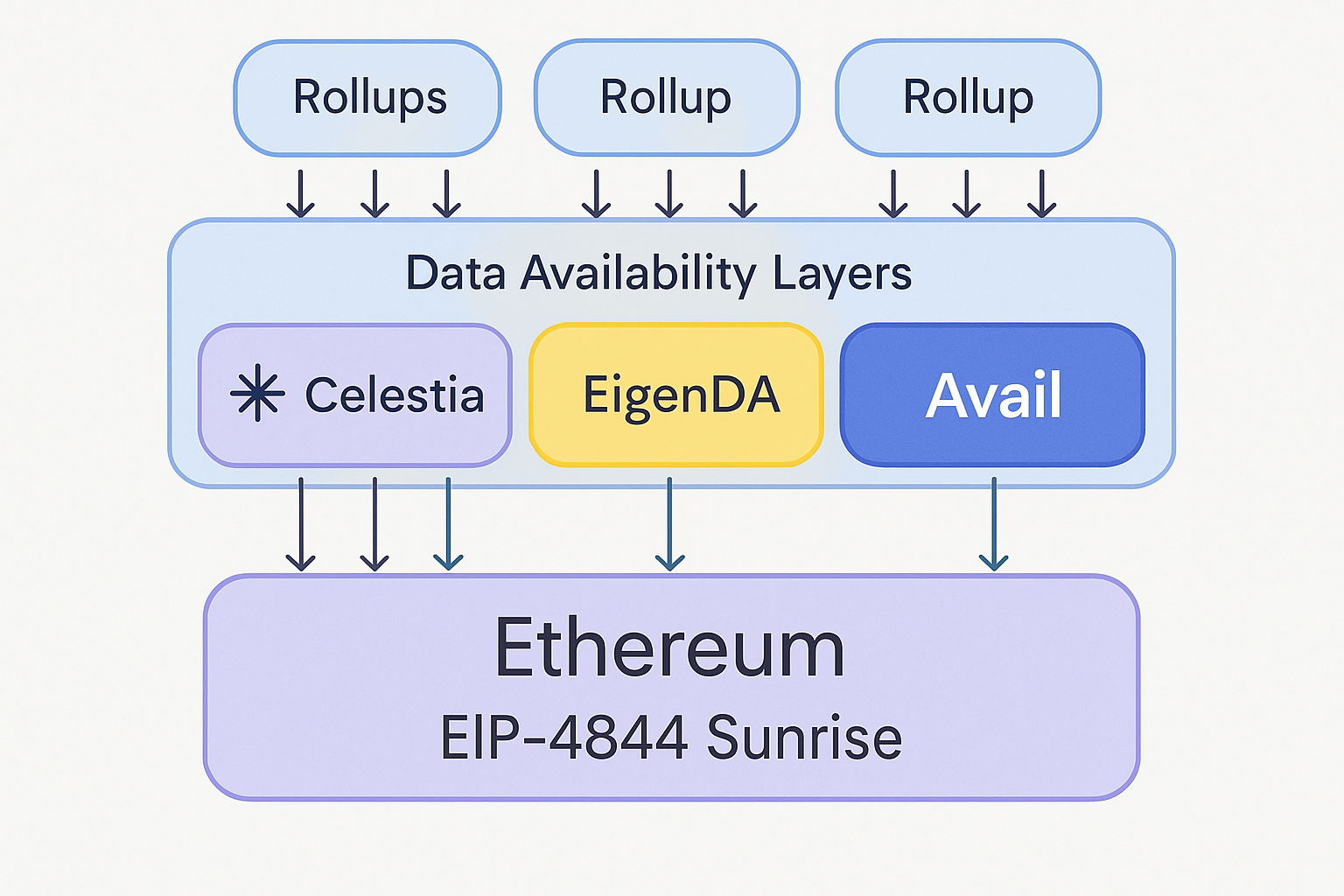
Rollups thrive by batching transactions, yet their Achilles' heel lies in ensuring every validator can access complete transaction data without downloading massive blocks. Ethereum's native DA capacity strains under this load, as Nansen Research notes, pushing rollups toward alternatives. Token Metrics ranks these solutions by costs, security, and features, signaling a shift where data availability rollups 2025 demand specialized infrastructure.
The Hidden Risks Undermining Rollup Security
Consider a rollup operator who withholds critical transaction data; validators can't reconstruct the state, opening doors to fraud. This data withholding attack plagues optimistic and zk-rollups alike, as outlined by 7blocklabs. Propagation lags compound the issue: in decentralized networks, data must fan out swiftly to all nodes, or delays erode liveness.
Storage costs bite hardest. Full on-chain publication devours Ethereum's block space, while compression trades verifiability for savings. Sunrise's Medium comparison highlights how Ethereum's EIP-4844 blobs alleviate this partially, yet fall short for hyperscale apps. These pain points demand modular DA layers Ethereum can plug into seamlessly.
Why Modular DA Layers Outpace Monolithic Chains
Modularity slices the blockchain trilemma, isolating DA for optimization. Celestia pioneered this with Data Availability Sampling (DAS), letting light nodes sample proofs without full downloads. Rollups publish calldata cheaply, scaling to millions of users. Polygon Avail extends this flexibility, tailoring DA for zk-rollups and slashing on-chain footprints, per goldrush. dev.
EigenDA leverages restaking for security, letting rollups cherry-pick providers based on cost-performance. In my analysis, blending EigenLayer's economics with pure DA creates resilient markets, far beyond Ethereum's overburdened blobs. t3rn's Layer 2 revolution piece nails it: separating storage from execution fuels the next phase.
Top 5 DA Layers Comparison for 2025
| DA Layer | Costs | Security Model | DAS Support | Rollup Compatibility | 2025 Features |
|---|---|---|---|---|---|
| Celestia | Highly cost-efficient (DAS reduces bandwidth needs) | Sovereign DA layer with decoupled consensus | Yes ✅ | Broad (Optimistic, ZK rollups, L2s) | Enhanced scalability, modular integrations, ARM previews |
| EigenDA | Competitive, balanced with performance | EigenLayer restaking (AVS-based) | Yes | Modular selection for various rollups | Improved cost-security tradeoffs, expanded ecosystem integrations |
| Avail | Low on-chain storage costs | Pluggable with tailored security | Yes | High (ZK-Rollups, Optimistic) | Flexibility for custom DA, Polygon ecosystem growth |
| EIP-4844 (Proto-Danksharding) | Reduced via blob transactions | Ethereum L1 security | Partial (blob sampling) | Ethereum rollups primarily | Full danksharding precursor, increased blob capacity |
| Sunrise | Cost-optimized for comparisons | Modular DA security | Yes | Wide rollup support | Advanced features in comparisons, ecosystem expansion |
Celestia and EigenDA: Benchmarking the Leaders
Celestia dominates with its sovereign DA chain, where rollups post data via pay-for-blobs. DAS ensures blockchain DA visibility challenges vanish; a few samples confirm full availability. Yet, as LinkedIn's Krzysztof Gogol observes, Celestia's usage dipped amid Ethereum DA shifts, prompting upgrades for interoperability.
EigenDA counters with Ethereum-aligned restaking, securing data via AVS (Actively Validated Services). Rollups gain customizable throughput, vital as Onchain predicts modular comebacks. Compare via this scalability guide: Celestia's pure modularity edges EigenDA's security depth for cost-sensitive builders.
Avail, from Polygon, bridges gaps with multi-chain compatibility, embedding KZG commitments for zk-proof synergy. Its pluggable design suits sovereign rollups, reducing reliance on Ethereum entirely. Sunrise enters as a contender, emphasizing developer-friendly features in Medium overviews, stacking against incumbents on propagation speed.
Ethereum's EIP-4844 marks a pragmatic evolution within the base layer itself. By introducing blobs for temporary data storage, it slashes costs for rollup calldata posting, boosting capacity without full sharding. Yet, as a stopgap, its fixed throughput pales against dedicated layers; Sunrise's overview underscores how EIP-4844 complements rather than competes with modular alternatives.
Tailoring DA for Rollup Flavors: Optimistic vs. ZK
Optimistic rollups, reliant on fraud proofs, crave cheap, verifiable data posting to deter withholding. Celestia excels here, its DAS enabling light-client checks that match optimistic assumptions. ZK-rollups, proving validity upfront, demand tighter integration; Avail's KZG commitments align perfectly, accelerating proof aggregation while keeping data visible off-Ethereum.
In practice, EigenDA's restaking model secures both paradigms, pooling Ethereum stakers for DA without diluting their duties. Sunrise differentiates with optimized propagation, targeting low-latency networks where delays kill user experience. My take: hybrid strategies win, mixing EIP-4844 blobs for bursts with Celestia for steady loads, as this modular rollups analysis explores.
Celestia Technical Analysis Chart
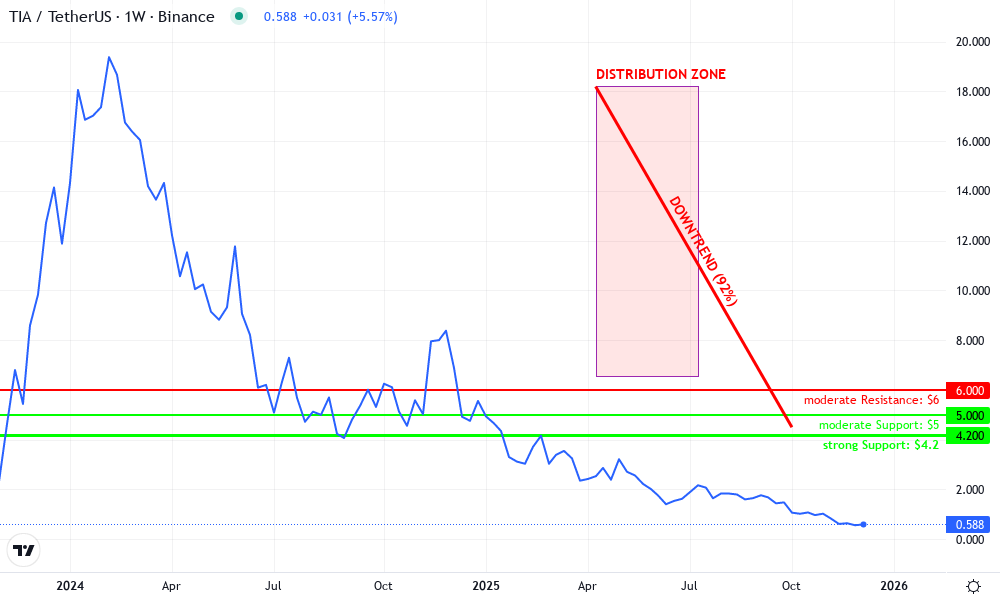
Analysis by Jillian Cross | Symbol: BINANCE:TIAUSDT | Interval: 1W | Drawings: 5
Technical Analysis Summary
In my conservative, fundamentals-driven style, accentuate the dominant downtrend with a thick red trend_line connecting the April 2025 peak near 18 to the October 2025 trough around 4.5, highlighting the bearish momentum. Overlay horizontal_lines at key support (4.2) and resistance (6.0, 8.5) levels for S/R zones. Use a light blue rectangle for the late-2025 consolidation range from September to October between 4.8-5.5. Add callout texts for volume decline and MACD bearish signal near recent bars. Place arrow_mark_down at the mid-2025 breakdown point. Employ fib_retracement from the major high to low for potential retracement levels at 23.6% (6.2) and 38.2% (7.8). Keep drawings minimalistic and precise to avoid clutter, emphasizing risk-off posture.
Risk Assessment: high
Analysis: Prolonged downtrend with declining volume indicates weak hands capitulated but no clear reversal; fundamentals supportive long-term but macro crypto risks loom in low-adoption DA niche
Jillian Cross's Recommendation: Sideline with low-risk tolerance—monitor for volume-backed break above 6.0 before small position; prioritize portfolio diversification over speculative crypto bets
Key Support & Resistance Levels
📈 Support Levels:
- $4.2 - Strong multi-touch base after capitulation, aligning with 78.6% Fib strong
- $5 - Intermediate support in consolidation zone moderate
📉 Resistance Levels:
- $6 - Recent swing high, 23.6% Fib retracement moderate
- $8.5 - Mid-channel resistance from July breakdown weak
Trading Zones (low risk tolerance)
🎯 Entry Zones:
- $4.5 - Dip buy at strong support if volume picks up, conservative long for fundamental rebound low risk
- $5.2 - Break above consolidation high for confirmation medium risk
🚪 Exit Zones:
- $6 - Initial profit target at resistance 💰 profit target
- $4 - Tight stop below base to limit downside 🛡️ stop loss
- $7.5 - Trailing stop or 38.2% Fib extension 💰 profit target
Technical Indicators Analysis
📊 Volume Analysis:
Pattern: declining on downtrend, low at bottoms
Shrinking volume confirms lack of buying conviction, potential exhaustion
📈 MACD Analysis:
Signal: bearish crossover persisting
MACD below zero with histogram contraction, no bullish divergence yet
Applied TradingView Drawing Utilities
This chart analysis utilizes the following professional drawing tools:
Disclaimer: This technical analysis by Jillian Cross is for educational purposes only and should not be considered as financial advice. Trading involves risk, and you should always do your own research before making investment decisions. Past performance does not guarantee future results. The analysis reflects the author's personal methodology and risk tolerance (low).
2025 Roadmaps: Upgrades and Interoperability
Looking ahead, Celestia's Blobstream v2 promises seamless Ethereum bridging, reclaiming market share from EIP-4844's dominance. EigenDA eyes AVS expansions for cross-chain DA, per Coinlive reports, while Avail pushes DA as a service for appchains. Sunrise focuses on developer tools, easing adoption for niche rollups.
Ethereum's roadmap tempers optimism; full danksharding lingers, leaving room for these specialists. Token Metrics' 2025 rankings favor Celestia for pure DA economics, EigenDA for security buffs. Onchain's predictions align: sovereign rollups armed with modular DA reshape consumer L2s, prioritizing data availability rollups 2025 over monolithic scaling.
Builders face choices amid Celestia EigenDA comparison debates. Celestia suits cost-first deployments, EigenDA security hawks, Avail zk purists, EIP-4844 Ethereum loyalists, and Sunrise speed demons. DroomDroom's selector guide echoes this: match DA to rollup needs for optimal throughput.
Modular DA isn't just technical; it's a governance shift, empowering rollups to vote with fees on the best availability providers.
As rollup TVL climbs, expect fierce competition. Techsandesh pits these layers on visibility metrics, where DAS-equipped options like Celestia lead. Yellow. com notes EigenLayer's interoperability push, potentially fusing Avail and Sunrise into ecosystems.
Proto-danksharding via EIP-4844 provides a baseline, but true visible data availability blockchain demands specialization. Rollups posting to diverse DA layers mitigate single points of failure, fostering resilience. Nansen warns Ethereum DA won't suffice; alternatives must proliferate.
For developers, start with compatibility audits. Celestia's SDKs lower barriers, EigenDA's AVS APIs add trust. Avail's pluggability shines for experiments, Sunrise for prototypes. In 2025, the smartest rollups orchestrate multiple DA backends, hedging risks while chasing efficiency.
This modular pivot resolves core tensions, turning blockchain DA visibility challenges into competitive edges. As capital flows to proven layers, watch Celestia rebound, EigenDA institutionalize, and newcomers like Sunrise disrupt. The era of plug-and-play DA heralds rollups that scale without compromise, securing Web3's expansion.




No comments yet. Be the first to share your thoughts!