

In 2026, rollup developers face a clear choice: stick with traditional data availability (DA) on Ethereum or pivot to modular DA layers like Celestia and Avail. The modular DA layers are delivering massive scalability wins, slashing costs, and unlocking throughput that monolithic setups just can't match. With Ethereum's DA clocking in at $20.56 per megabyte, while Celestia offers $7.31 per megabyte and SuperBlobs drop it to $0.81 per megabyte, the math is straightforward. Rollups posting data here aren't just surviving; they're thriving in a hyper-competitive Layer 2 landscape.

Traditional DA bundles execution, consensus, and availability into one rigid chain. Ethereum's model worked fine in the early days, but as transaction volumes explode, it chokes. Every block must be fully downloaded and verified by all nodes, driving up costs and capping scalability. Rollups relying on Ethereum's DA pay a premium for this inefficiency, limiting how many transactions they can process affordably.
Monolithic Chains Hit Scalability Walls
Monolithic blockchains like Ethereum integrate everything: execution, consensus, and DA. This all-in-one design made sense for simplicity back in 2015, but in 2026's data availability blockchain era, it's a bottleneck. Full nodes must store and verify every byte, leading to bloated chains and skyrocketing fees during peak demand. For rollup developers, posting transaction data to Ethereum means coughing up $20.56 per megabyte, a figure that hasn't budged much despite L2 optimizations.
Contrast that with modular approaches. By separating DA into specialized layers, rollups offload the heavy lifting. Light nodes use Data Availability Sampling (DAS) to check data without full downloads. Celestia pioneered this, proving you can scale verification to millions of nodes without compromising security. Developers get flexibility: pick your execution environment, your sequencer, and plug in a DA layer that fits your budget and throughput needs.
Modular DA Layers vs Traditional DA: 6-Month Price Performance (2026)
Celestia (TIA) and key competitors in modular blockchain and L2 scalability amid market downtrend
| Asset | Current Price | 6 Months Ago | Price Change |
|---|---|---|---|
| Celestia (TIA) | $0.4049 | $0.5698 | -28.9% |
| Ethereum (ETH) | $2,738.72 | $3,200.00 | -14.4% |
| EigenLayer (EIGEN) | $0.2917 | $0.3500 | -16.6% |
| Avail (AVAIL) | $0.005549 | $0.006500 | -14.6% |
| Arbitrum (ARB) | $0.1546 | $0.1800 | -14.1% |
| Optimism (OP) | $0.2639 | $0.3000 | -12.0% |
| Polygon (POL) | $0.1108 | $0.1250 | -11.3% |
| NEAR Protocol (NEAR) | $1.33 | $1.50 | -11.3% |
| Solana (SOL) | $115.25 | $130.00 | -11.3% |
Analysis Summary
Over the past six months, all tracked assets have declined in a broader market downtrend, with Celestia (TIA) showing the steepest drop at -28.9%. Modular DA peers like EigenLayer (-16.6%) and Avail (-14.6%) fell less severely, while Ethereum declined 14.4% and L2 leaders like Solana, Polygon, and NEAR around -11.3%, highlighting relative resilience in established scalers despite Celestia's DA cost advantages ($7.31/MB vs Ethereum's $20.56/MB).
Key Insights
- Celestia (TIA) underperformed with a -28.9% decline, reflecting asset-specific pressures amid modular DA adoption.
- Ethereum (ETH) down -14.4%, baseline for traditional DA costs.
- EigenLayer (EIGEN) and Avail (AVAIL) declined -16.6% and -14.6%, competitive in modular space.
- L2 assets like Polygon (POL), Solana (SOL), and NEAR showed mildest drops at -11.3%.
- No assets posted gains, aligning with the general crypto market downtrend over six months.
Real-time prices from CoinMarketCap (e.g., Celestia data as of 2026-01-30T06:05:16Z, 6 months prior ~2025-08-03). Percentage changes calculated directly from provided current and historical prices.
Data Sources:
- Main Asset: https://coinmarketcap.com/currencies/celestia/tia/eth/
- Ethereum: https://coinmarketcap.com/currencies/ethereum/
- EigenLayer: https://coinmarketcap.com/currencies/eigenlayer/
- Avail: https://coinmarketcap.com/currencies/avail/
- Arbitrum: https://coinmarketcap.com/currencies/arbitrum/
- Optimism: https://coinmarketcap.com/currencies/optimism/
- Polygon: https://coinmarketcap.com/currencies/polygon/
- NEAR Protocol: https://coinmarketcap.com/currencies/near-protocol/
- Solana: https://coinmarketcap.com/currencies/solana/
Disclaimer: Cryptocurrency prices are highly volatile and subject to market fluctuations. The data presented is for informational purposes only and should not be considered as investment advice. Always do your own research before making investment decisions.
Modular DA Unleashes Rollup Potential
Rollup scalability DA hinges on modular DA layers. Celestia, the first to cleanly separate DA from execution and consensus, lets rollups publish blobs at a fraction of Ethereum's cost. Those SuperBlobs? Game-changer at $0.81 per megabyte, enabling high-throughput apps like DeFi protocols or social dApps to hum without fee spikes. Avail joins the fray with its focus on lightweight DA, turning rollups into Validiums or sovereign stacks that prioritize speed and customization.
EigenDA, resting on EigenLayer's restaking, adds another angle with Ethereum-aligned security. But the real edge comes in developer freedom. No longer chained to Ethereum's calldata limits, teams build optimistic or ZK rollups that settle faster and cheaper. Check out how modular data availability layers improve rollup scalability; the principles hold strong into 2026.
This modularity isn't hype; it's deployed reality. Rollups on Celestia handle gigabytes daily, with DAS ensuring data's there without trust assumptions crumbling. Costs plummet, throughput soars, and developers iterate faster on modular blockchain DA solutions.

Celestia EigenDA Comparison Reveals Clear Leaders
Diving into Celestia EigenDA comparison, Celestia leads with native DAS and sovereign DA, no restaking middleman. Posting fees? $7.31 per megabyte standard, $0.81 with SuperBlobs. EigenDA leverages Ethereum restakers for security but inherits some calldata dependencies, pushing costs higher than pure modular plays. Avail? KZenon's brainchild offers erasure coding for compact data proofs, ideal for bandwidth-strapped rollups.
Each shines differently. Celestia for raw scalability, EigenDA for Ethereum loyalists, Avail for minimalists. But all beat Ethereum's $20.56 per megabyte stranglehold. Developers mixing and matching these create bespoke stacks: ZK execution on a custom VM, optimistic sequencing, DA on Celestia. The result? TPS numbers that make monolithic chains look quaint.
Fragmentation worries some, with varied security models across DA layers. Yet, interoperability bridges and shared standards mitigate this. In practice, rollups thrive, posting data off-chain while inheriting robust availability guarantees. For 2026 rollup builders, modular DA isn't optional; it's the scalability multiplier you need to outpace competitors.
Rollup teams stacking Celestia or Avail see TPS climb into the tens of thousands, while Ethereum-tied rollups grind against calldata congestion. This isn't theory; it's battle-tested in production DeFi and gaming rollups posting terabytes monthly.
Real-World Scalability Benchmarks
In the data availability blockchain 2026 arena, numbers don't lie. Celestia's network processes over 1 GB per block with DAS verifying availability in milliseconds. Rollups like Dymension leverage this for app-specific chains that settle batches lightning-fast. Ethereum's $20.56 per megabyte DA? It's a drag on optimistic rollups during volatility spikes, forcing sequencers to batch less and users to wait longer.
Avail's erasure-coded proofs shrink data footprints by 50%, perfect for bandwidth-hungry social or AI apps. Developers report 10x cost reductions when migrating from Ethereum DA. EigenDA appeals to restaking fans, but its Ethereum anchor means occasional fee volatility. Pick based on your stack: sovereign rollups love Celestia's independence, Ethereum L2s lean EigenDA.
Celestia Technical Analysis Chart
Analysis by Market Analyst | Symbol: BINANCE:TIAUSDT | Interval: 1D | Drawings: 7
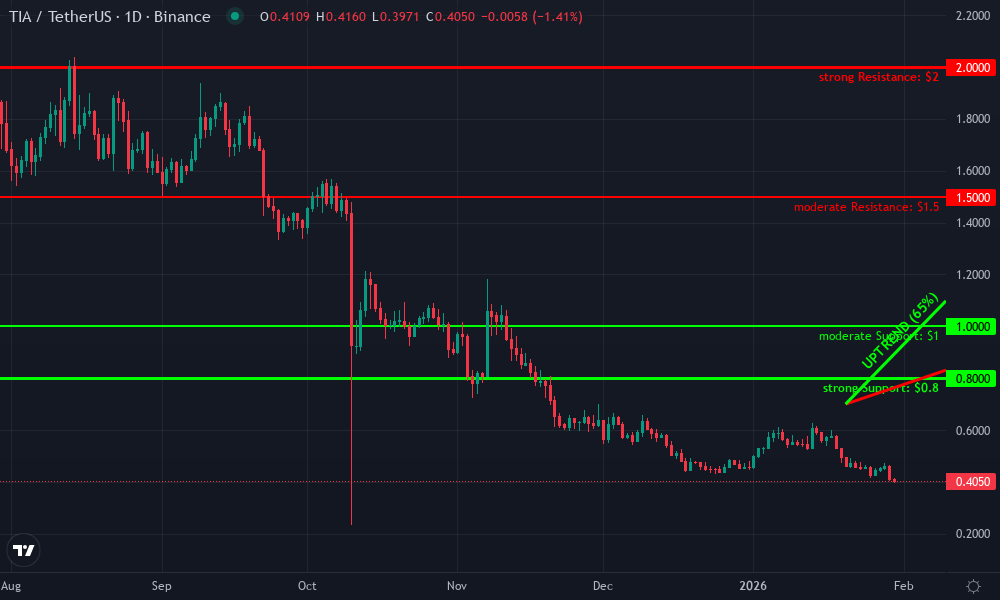
Technical Analysis Summary
To annotate this Celestia (TIAUSDT) chart in my balanced technical style, start with a prominent downtrend line connecting the October 2026 high around $2.40 to the late December 2026 low near $0.70, using 'trend_line' tool in red. Add a shorter-term uptrend line from the January 2026 low at $0.70 to the recent February high at $1.20 in green. Mark key horizontal support at $0.80 and $1.00, resistance at $1.50 and $2.00 with horizontal_lines. Use fib_retracement from the major downswing for potential retracement levels. Highlight the recent accumulation range with rectangle from mid-January to now between $0.80-$1.20. Add callouts for volume spike on breakdown and MACD bullish crossover. Place arrow_mark_up at recent entry zone around $1.05 and text notes for risk-managed trades.
Risk Assessment: medium
Analysis: Choppy post-downtrend action with bullish signals but overhead resistance; aligns with my medium tolerance avoiding aggressive calls
Market Analyst's Recommendation: Wait for close above $1.20 uptrend line for longs, target $1.50; scale out on weakness
Key Support & Resistance Levels
📈 Support Levels:
- $0.8 - Strong support from December-January lows, multiple tests strong
- $1 - Recent consolidation base, volume-backed moderate
📉 Resistance Levels:
- $1.5 - Near-term resistance from prior swing highs moderate
- $2 - Psychological and prior rally hurdle strong
Trading Zones (medium risk tolerance)
🎯 Entry Zones:
- $1.05 - Bounce from $1.00 support with bullish candle and volume uptick medium risk
🚪 Exit Zones:
- $1.5 - First profit target at resistance confluence 💰 profit target
- $0.95 - Tight stop below recent lows for medium risk tolerance 🛡️ stop loss
Technical Indicators Analysis
📊 Volume Analysis:
Pattern: decreasing on decline, increasing on recent bounce
Bullish divergence suggesting weakening sellers
📈 MACD Analysis:
Signal: bullish crossover in late January
MACD line crossing signal from below, momentum shift
Applied TradingView Drawing Utilities
This chart analysis utilizes the following professional drawing tools:
Disclaimer: This technical analysis by Market Analyst is for educational purposes only and should not be considered as financial advice. Trading involves risk, and you should always do your own research before making investment decisions. Past performance does not guarantee future results. The analysis reflects the author's personal methodology and risk tolerance (medium).
These layers aren't perfect. Modular DA introduces sequencer centralization risks and cross-chain bridging complexities. But tools like shared sequencers and atomic composability protocols are closing gaps fast. Rollups on modular DA post data once, settle anywhere, inheriting availability without Ethereum's overhead.
Cost Breakdown: Why Modular Wins Hands Down
Let's crunch it. A DeFi rollup posting 10 MB daily on Ethereum shells out $205.60. Switch to Celestia: $73.10 standard, or $8.10 with SuperBlobs. Over a month, that's thousands saved, straight to treasury or user rebates. Avail matches closely with sub-$1 MB options via data compression. These savings fuel marketing, security audits, and UX polish, giving modular rollups the edge in user acquisition wars.
Don't sleep on SuperBlobs. Celestia's upgrade bundles multiple blobs efficiently, slashing marginal costs as volume ramps. For high-TPS apps, this means profitability at sub-cent per transaction. Traditional DA can't compete; it's structurally inflationary on storage and verification.
Fragmentation? Sure, but it's healthy competition driving innovation. DA layers battle on uptime, cost, and features, benefiting developers. Interop standards like the Interoperability Protocol ensure rollups swap DA providers seamlessly if needed.
Building Your Modular Rollup Stack in 2026
Start with needs assessment: throughput first, then security model. ZK rollups pair best with Celestia's DAS for instant proofs. Optimistic? Avail's Validium mode cuts risks. Integrate via SDKs; Celestia's rollkit kit deploys a chain in hours. Test on testnets, monitor costs, and scale.
Check how modular data availability layers are cutting rollup fees for deployment blueprints. The playbook is simple: decouple DA, specialize execution, and watch scalability explode.
By mid-2026, expect 70% of new rollups to shun Ethereum DA entirely. Modular rollup scalability DA isn't a trend; it's the new baseline. Developers ignoring it risk irrelevance as competitors post cheaper, faster, and bigger. Celestia holds the lead, but Avail and EigenDA keep it fierce. Your move: build modular, scale ruthlessly, win big.




No comments yet. Be the first to share your thoughts!