

Blockchain scalability remains the holy grail, yet traditional Layer 1 networks like Ethereum, currently trading at $2,170.03 after a 4.39% dip over the past 24 hours, struggle under transaction volume. Enter modular architectures, where data availability layers and Layer 2 rollups tackle this differently. Rollups accelerate execution off-chain, but without robust data availability, they risk verification black holes. Data availability layers, or DALs, step in as dedicated data custodians, unlocking true modularity. This piece dissects their differences, revealing why combining them powers next-gen scalability.
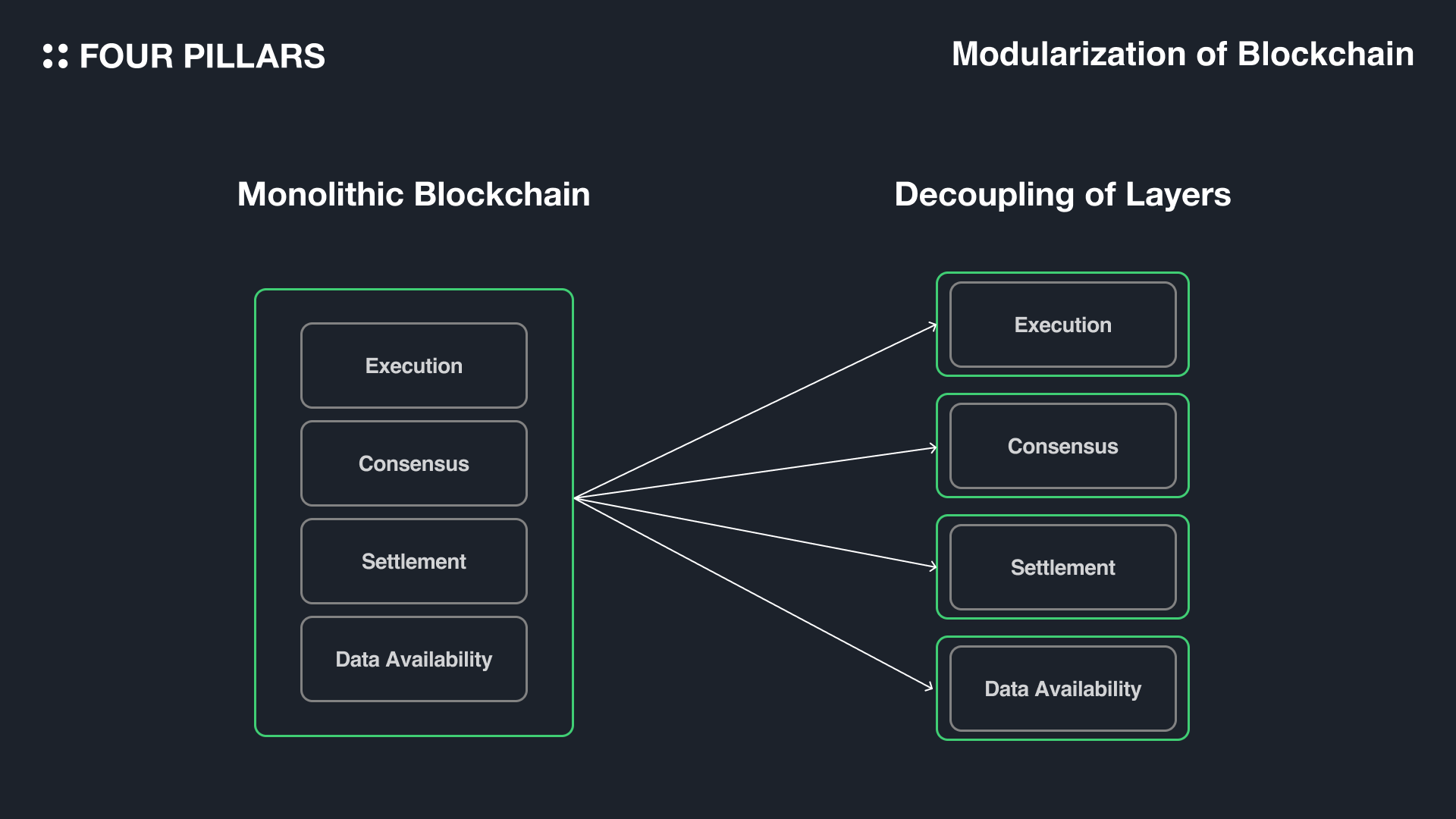
Modular blockchains decouple execution, settlement, and data availability, echoing Celestia's vision. Rollups shine in execution, compressing thousands of transactions into succinct proofs or data batches posted to Layer 1. Optimistic rollups assume validity, challenging fraud proofs within a window; zk-rollups prove validity cryptographically upfront. Both slash costs and boost throughput, yet they lean heavily on Layer 1 for data posting. Ethereum's block space, even post-Dencun, caps this at pricey calldata levels.
Layer 2 Rollups: Execution Powerhouses with Data Dependencies
Layer 2 rollups represent Ethereum's scaling frontrunner. They process transactions off-chain, batch them, and anchor to L1 for security. This setup yields 10x-100x throughput gains, vital as ETH hovers around $2,170.03 amid scalability demands. Optimistic variants like Base or Arbitrum post compressed transaction data, enabling anyone to reconstruct state. ZK-rollups, such as Polygon zkEVM, submit validity proofs sans full data, trimming costs further.
Yet herein lies the rub: rollups inherit L1's data availability limits. Posting full data ensures verifiability, but Ethereum's 1-2 MB blocks constrain scale. "Data availability" means anyone can fetch and check transaction data without trusting operators. Without it, malicious sequencers could withhold data, freezing challenges. Rollups mitigate via L1 posting, but at escalating fees during congestion.
Rollups are preferred for Ethereum scaling today, but data availability policies demand scrutiny.
This dependency bottlenecks true modularity. As networks grow, L1 data posting becomes unsustainable, pushing costs back to users.

Data Availability Layers: Specialized Data Anchors
Data availability layers flip the script, isolating data storage from execution and consensus. Pioneers like Celestia and Avail DA layer for Ethereum specialize here, using techniques like data availability sampling (DAS). Nodes sample block shards, probabilistically confirming availability without downloading everything. This enables massive blocks; Celestia targets 1 GB, dwarfing Ethereum's limits.
DALs publish rollup data independently, attestable via light clients. Rollups connect via bridges, posting only headers or proofs to L1 or settlement layers. Result? Cheaper, faster scaling. Zeeve notes DALs streamline data to L1/L2 nodes, boosting security. Modular DA allows bigger blocks since compute isn't shared, per Ethereum Research.
Consider Celestia: its sovereign DA chain uses erasure coding and DAS for efficiency. Avail integrates natively with Ethereum rollups, slashing calldata needs. These layers redefine scalability, offloading data burdens so rollups focus on execution.
Explore how DALs enhance rollup performance in depth.Key Differences Unpacked: From Dependencies to Independence
At core, DA layers vs L2 rollups diverge in function. Rollups optimize execution, bundling txs off-chain while relying on L1 DA. DALs own data availability, serving as neutral hubs for any rollup or app.
L2 Rollups vs. Data Availability Layers: Key Differences for Modular Blockchain Scalability
| Feature | Layer 2 Rollups | Data Availability Layers |
|---|---|---|
| Throughput | High (e.g., 2,000+ TPS via off-chain batching) 🚀; Pro: Scales execution; Con: Limited by L1 data posting capacity | Ultra-high potential (larger blocks, modular design) 📈; Pro: Removes DA bottleneck for rollups; Con: Dependent on integration with execution layers |
| Cost | Low tx fees vs. L1; Pro: Cheaper execution; Con: Expensive L1 calldata posting (~$0.50-$5 per batch on Ethereum) | Very low data storage costs; Pro: Offloads DA from L1; Con: Emerging, variable fees based on network load |
| Data Storage | Posts compressed data to L1 (e.g., Ethereum calldata); Pro: Leverages L1 security; Con: Constrained by L1 block space | Dedicated layer for tx data (e.g., blobs, erasure coding); Pro: Scalable, efficient; Con: Requires DA proofs/sampling for verification |
| Security Model | Inherits L1 consensus/security; Pro: Fraud/validity proofs; Con: Relies on L1 for data availability | Provides DA guarantees (e.g., sampling, KZG commitments); Pro: Ensures data retrievability; Con: Newer, needs L1 settlement for finality |
| Examples | Optimistic: Arbitrum, Optimism; ZK: zkSync, Polygon zkEVM | Celestia, Avail, EigenDA |
Rollups excel in speed and cost for user txs but scale linearly with L1 space. DALs scale data quadratically via sampling, theoretically unbounded. For modular blockchain DA, DALs enable "trust-minimized" rollups at sub-cent fees. L1 posting? Legacy constraint. Sovereign DA? Future-proof.
Security-wise, rollups borrow L1 consensus; DALs layer economic guarantees like slashing for non-availability. Hybrids emerge: rollups using Celestia DA post calldatas there, settling on Ethereum. This synergy crushes monolithic limits, as LCX highlights in redefining blockchain scalability.
Hybrids like these are already live, with projects such as Arbitrum Orbit chains experimenting with Celestia for data posting. This setup lets rollups sidestep Ethereum's calldata crunch, where fees spike during peaks even as ETH sits at $2,170.03. Developers gain flexibility: settle on Ethereum for security, store data cheaply on a DAL. It's pragmatic scalability, not theoretical fluff.
Real-World Impact: Celestia, Avail, and Beyond
Celestia leads the charge in Celestia data availability, its mainnet handling gigabyte blocks via DAS. Rollups like Dymension post data there, achieving 100x cost reductions versus Ethereum L1. Avail, tailored for Avail DA layer Ethereum, offers KZG commitments for succinct proofs, integrating seamlessly with OP Stack and zk chains. EigenDA, from EigenLayer, leverages restaked ETH for economic security, blending restaking with DA.
Key DA Layer Projects
| Project | Block Size | Sampling Method | Key Integrations | Cost Savings vs Ethereum L1 |
|---|---|---|---|---|
| Celestia | 1GB | DAS | Dymension/rollups | 100x |
| Avail | 440MB | KZG | Ethereum rollups | 50x |
| EigenDA | Dynamic | Restaking | EigenLayer ecosystem | 90x |
These aren't silos; they're interoperable. A rollup can swap DA providers, fostering competition that drives fees down. As Ethereum's Dencun upgrade introduced blobs, it eased rollup costs temporarily, but dedicated DALs promise sustained efficiency. With ETH at $2,170.03 reflecting market caution amid upgrades, DAL adoption signals bullish infrastructure bets.
Pragmatically, rollups without DALs face a scalability cliff. L1 data posting works for now, but as TVL swells, it's like pouring ocean water through a straw. DALs expand the pipe, enabling modular blockchain DA at internet scale.


Synergies in Action: Maximizing Modular Scalability
Pairing DA layers vs L2 rollups unlocks exponential gains. Rollups handle execution at 10,000 and TPS; DALs ensure data flows freely. Light clients verify availability remotely, no full downloads needed. This modularity echoes cloud computing: specialize layers, optimize each.
Take a DeFi app: zk-rollup executes trades off-chain, Celestia stores batch data, Ethereum settles disputes. Users pay pennies, not dollars. Security holds via multi-layered proofs. Messari underscores DA's criticality for rollups relying on L1 security; DALs extend this without bloating L1.
Dive into DALs powering Ethereum rollups. Such combos cut latency, boost UX, and scale globally. Ethereum Research notes modular DA's bigger blocks free compute for other chains.Challenges persist, though. DAS assumes honest samplers; attacks could withhold data. Economic security via staking mitigates, but nascent networks risk. Interoperability standards lag, complicating bridges. Still, progress accelerates: Celestia's TIA token thrives, Avail eyes mainnet.
For developers, the choice clarifies: build rollups for execution prowess, plug into DALs for data scale. Institutions eyeing blockchain see reliability; retail users get cheap, fast txs. As ETH navigates $2,170.03 volatility, modular stacks position Ethereum dominant. Sovereign rollups with dedicated DA herald 2025's throughput revolution, where scalability isn't compromised, it's engineered.
See projections for DA-enhanced rollups in 2025.



No comments yet. Be the first to share your thoughts!