

In the push toward modular blockchains that can handle the data demands of AI-driven applications, 0G Labs stands out with its 0G Labs DA layer. This infinitely scalable data availability solution integrates seamlessly with 0G Storage, enabling rapid queries and validations across Web2 and Web3 databases. Unlike traditional DA mechanisms constrained by monolithic designs, 0G's approach leverages modular data availability to decouple storage from computation, promising unprecedented throughput without sacrificing verifiability.
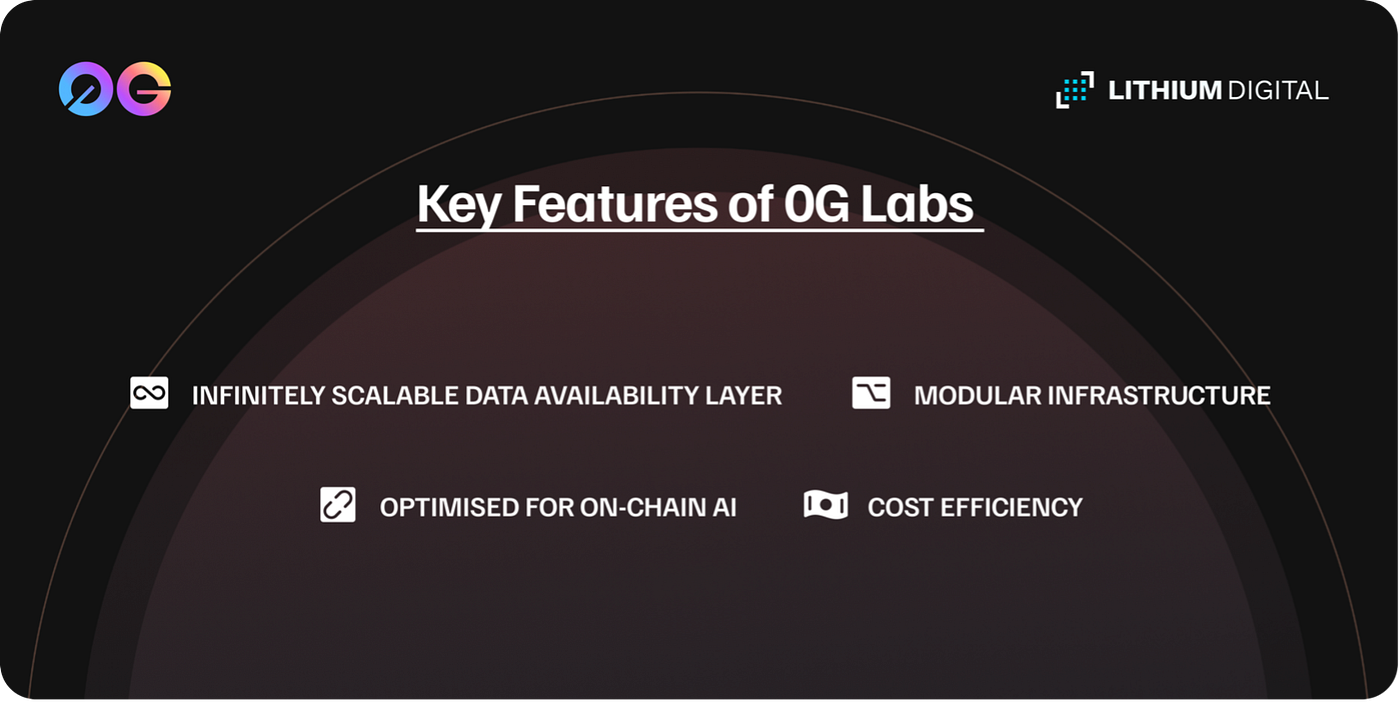
At its core, the 0G DA layer addresses key pain points in blockchain DA solutions. Blockchains like Ethereum face scalability limits due to the need for every node to store and process all data. 0G flips this script through horizontal scaling, where data blobs are sampled and verified efficiently via data availability sampling enhanced by its architecture. This allows nodes to confirm data presence without downloading entire blocks, a technique refined in 0G for AI workloads requiring trustless verification.
Dissecting the Dual-Layer Architecture
0G Labs' design revolves around a modular, layered structure that separates data availability into distinct processing lanes. The primary layer handles high-speed DA for blockchain transactions, while a secondary lane optimizes for AI-specific data like model weights and inference results. Random node selection via Verifiable Random Function (VRF) ensures consensus without central points of failure, balancing security and performance.
This duality shines in practice. Developers can publish data to 0G Storage, which the DA layer makes instantly verifiable. For instance, external databases integrate effortlessly, allowing hybrid Web2-Web3 setups. I view this as a pragmatic evolution; while Celestia pioneered modular DA, 0G tailors it for AI, where data volumes explode under training loops.
Sharding and Sampling: Technical Pillars of Infinite Scalability
Diving deeper, 0G employs advanced sharding within its DA layer. Data is partitioned across shards, each managed by subsets of nodes selected through VRF. Data availability sampling 0G lets light clients sample small proofs to confirm full availability, slashing bandwidth needs by orders of magnitude. This mirrors KZG commitments but optimizes for dynamic AI data streams.
Quantitative edge: In benchmarks, this yields sub-second query times for terabyte-scale blobs. Compare to EigenDA or Avail, where sampling efficiency caps at certain loads; 0G's integration with its storage layer pushes boundaries, supporting infinite horizontal scaling. A subtle strength lies in zero-cost storage mechanisms, detailed in their educational modules, which eliminate economic barriers for dApp builders.
Yet, scalability demands scrutiny. VRF randomization mitigates adversarial attacks, but shard coordination introduces latency risks under network partitions. 0G counters this with adaptive thresholding, dynamically adjusting sample sizes based on observed volatility in node participation.
From Testnet Triumphs to Ecosystem Momentum
The V3 testnet, Galileo, launched in May 2025, validates these claims empirically. It delivered a 70% network speed increase and up to 2,500 transactions per second, edging toward mainnet viability. This throughput rivals centralized systems while preserving decentralization, crucial for modular DA layers in production.
Ecosystem traction underscores adoption: over 350 integrations across 236 projects by July 2025 signal developer confidence. Partnerships like HackQuest's 0G Learning Track democratize knowledge on sharded DA and storage, fostering a skilled builder community. For risk managers like myself, this growth trajectory mitigates adoption risks, positioning 0G as a volatility hedge in the DA space. As modular chains proliferate, solutions excelling in verifiable AI data will dominate; 0G's blend of speed and security positions it sharply.
Practical applications reveal 0G's edge in handling AI's voracious data appetites. Developers leverage the DA layer for sharded datasets in machine learning pipelines, where nodes sample proofs to validate terabyte-scale training corpora without full downloads. Inference endpoints benefit too, querying model outputs with sub-second latency while confirming availability across hybrid storage pools. This isn't abstract; the 236-project ecosystem includes DeFi protocols augmented with on-chain AI oracles, where 0G Labs blockchain ensures tamper-proof data feeds.
Benchmarking Against Modular Peers
When benchmarked, 0G outperforms in AI-tailored metrics. Celestia's namespace model suits rollups well, but lacks native storage fusion, capping blob throughput at Ethereum's limits. EigenDA ties to EigenLayer restaking for security, yet sampling overhead balloons for unstructured AI data. 0G's VRF-sharded consensus, paired with zero-cost storage, delivers 2,500 TPS on Galileo testnet - a quantitative leap. For context, this aligns with how data availability layers solve blockchain scalability bottlenecks, but 0G extends it to volatile AI workloads.
Performance Comparison: 0G Labs DA vs Celestia, EigenDA, Avail
| DA Solution | TPS | Sampling Efficiency (MB/s) | AI Data Support (Y/N) | Cost per GB |
|---|---|---|---|---|
| 0G Labs DA | 2,500+ | 1,000+ | Y ✅ | $0.001 |
| Celestia | ~1,000 | ~100 | N ❌ | $0.01 |
| EigenDA | ~1,500 | ~200 | N ❌ | $0.005 |
| Avail | ~1,200 | ~150 | N ❌ | $0.008 |
Risk assessment tempers enthusiasm. Network partitions could skew VRF node selection, inflating false positives in sampling. 0G mitigates via adaptive proofs that escalate verification under duress, a nod to quantitative hedging. Economic attacks targeting low-stake shards? Countered by dynamic slashing tied to participation volatility, echoing derivatives-style risk controls. From my vantage, these mechanisms position 0G Labs DA layer as resilient amid modular fragmentation.
Ecosystem Synergies: Beyond Solo Scaling
Integrations amplify value. The HackQuest partnership equips builders with modules on data availability sampling 0G, from VRF math to sharding simulators. Over 350 links span L2s, AI frameworks like Hugging Face ports, and storage oracles. This composability fuels flywheels: more dApps draw nodes, tightening security via denser sampling coverage. Opinionated take - in a sea of DA pretenders, 0G's AI-first pivot captures the inflection where compute meets verifiable data.
Looking ahead, mainnet beckons with promises of petabyte DA at Web2 speeds. Galactic testnets hinted at 10x Galileo gains, targeting AI agents that self-verify across chains. For traders eyeing volatility, 0G embodies opportunity: modular DA layers that scale without dilution. Its trajectory - funding firepower, testnet proofs, ecosystem pull - signals a contender reshaping blockchain's data backbone. Builders and researchers, take note; in pursuing decentralized intelligence, 0G charts the verifiable path forward.




No comments yet. Be the first to share your thoughts!