
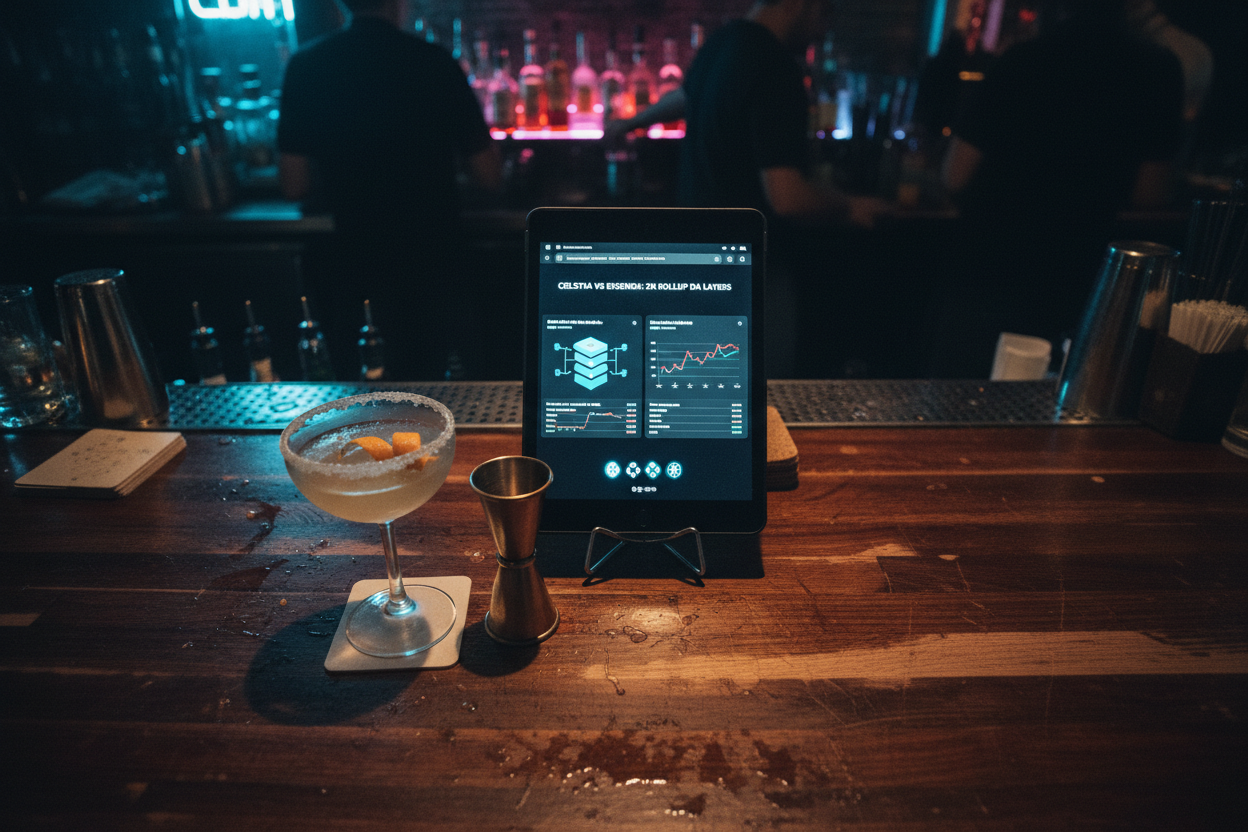
In the modular blockchain landscape of 2026, ZK rollups demand data availability layers that balance scalability, security, and cost without compromising decentralization. Celestia and EigenDA stand out as frontrunners, each carving distinct paths in this competitive arena. With Celestia's TIA trading at $0.3265 amid a 24-hour gain of and $0.0231, and Ethereum at $1,963.93, market dynamics underscore the stakes for rollup builders eyeing long-term viability.
Celestia's ascent reflects a pure play on modularity, decoupling data availability from execution and consensus. Its Data Availability Sampling (DAS) lets light clients verify massive blocks efficiently, a boon for ZK rollups handling voluminous proofs. Yet, as rollups scale, questions linger on fraud-proof finality windows versus validity proofs' instant settlement.
Celestia's Path to 1GB Blocks and Beyond
The Matcha upgrade in late 2025 propelled Celestia to 128MB blocks, with 1GB targets firmly in sight for 2026. This evolution addresses early critiques of throughput lagging behind Ethereum's blobs. DAS remains the linchpin, enabling 1,000s of light nodes to sample data shards, fostering true decentralization absent in committee-based models. For ZK rollups, this means sovereign data posting without Ethereum's calldata bloat or blob limits.
Consider a high-TPS DeFi rollup: Celestia's public verifiability ensures anyone can challenge invalid data, aligning with ZK's cryptographic rigor. However, the dispute window-typically 7 days-poses a finality trade-off. Rollups prioritizing economic finality might layer on optimistic mechanisms, but purists argue this dilutes modularity's promise.
By end of 2026, Celestia's throughput will be competitive with EigenDA, but with public verifiability intact.
This projection from BlockEden. xyz highlights Celestia's resilience, even as competitors slash prices. TIA's modest $0.3265 price belies network momentum, with rollups like Dymension thriving on its stack.
EigenDA's Ethereum-Aligned High-Speed Engine
EigenDA, powered by EigenLayer restaking, flips the script with blistering 100MB/s throughput by early 2026-far eclipsing Celestia's current specs. Ethereum stakers secure the Data Availability Committee (DAC), blending familiarity with aggressive scaling. For Ethereum-centric ZK rollups, this seamless integration trumps Celestia's sovereignty, especially post-Dencun where blobs cap at 384KB per block.
The DAC model stakes ETH for operator honesty, slashing for downtime or malice. It's economically robust, backed by billions in restaked capital, but introduces centralization risks if operator diversity falters. ZK rollups benefit from sub-second DA commitments, slashing latency for cross-rollup composability. Yet, reliance on restaking's permissionless operator growth tempers enthusiasm; what if AVS saturation curbs yields?
EigenDA's aggressive pricing-10x cuts and free tiers-demonstrates VC-fueled disruption. As subsidies wane, true costs will surface, potentially favoring Celestia's sustainable model for cost-sensitive rollups.
Throughput and Cost Realities for ZK Rollup Builders
Pitting Celestia against EigenDA reveals stark trade-offs. EigenDA's raw speed suits data-heavy ZK apps like gaming rollups, posting proofs without bottlenecks. Celestia counters with DAS-driven efficiency, projecting parity by year-end per analyst forecasts.
| Metric | Celestia | EigenDA |
|---|---|---|
| Throughput (2026 est. ) | 1GB blocks via DAS | 100MB/s via DAC |
| Finality | Fraud proofs (dispute window) | Restaking slashes (quick) |
| Cost (per MB) | Competitive, sustainable | Subsidized low, rising post-VC |
| Security | Public sampling | Ethereum-aligned restaking |
ZK rollups dissecting these metrics prioritize throughput for user growth versus decentralization for resilience. ChainScore Labs' analysis pegs EigenDA costs lower short-term, but Celestia's modularity shines in multi-chain futures. Deep DA comparisons affirm this nuance.
Celestia (TIA) Price Prediction 2027-2032
Projections based on 2026 baseline (Bear: $0.20, Base: $0.50, Bull: $1.20), DA competition with EigenDA/Avail, ZK rollup adoption, throughput upgrades, and market cycles.
| Year | Minimum Price | Average Price (YoY % from prior) | Maximum Price |
|---|---|---|---|
| 2027 | $0.25 | $0.65 (+30%) | $1.80 |
| 2028 | $0.40 | $1.30 (+100%) | $4.00 |
| 2029 | $0.60 | $2.20 (+69%) | $6.50 |
| 2030 | $0.90 | $3.50 (+59%) | $10.00 |
| 2031 | $1.30 | $5.00 (+43%) | $15.00 |
| 2032 | $1.80 | $7.50 (+50%) | $22.00 |
Price Prediction Summary
TIA price is forecasted to grow progressively from 2027-2032, with average prices rising from $0.65 to $7.50 amid DA layer dominance potential, scalability improvements like 1GB blocks, and bull market cycles. Bear cases reflect intense competition, while bull cases assume Celestia captures significant ZK rollup market share.
Key Factors Affecting Celestia Price
- Celestia throughput scaling (128MB to 1GB blocks via Matcha upgrade) competing with EigenDA's high TPS
- Adoption trends in ZK rollups favoring Celestia's DAS for decentralization vs. EigenDA's DAC/restaking
- Modular blockchain wars with Avail and Ethereum Danksharding impacting market share
- Crypto market cycles: potential bears in 2027/2029, bulls in 2028/2032
- Regulatory developments enabling L2/rollup growth and institutional inflows
- Risks from competitor subsidies, fraud-proof finality delays, and Ethereum-aligned preferences
Disclaimer: Cryptocurrency price predictions are speculative and based on current market analysis. Actual prices may vary significantly due to market volatility, regulatory changes, and other factors. Always do your own research before making investment decisions.
As ZK ecosystems mature, builders weigh EigenDA's Ethereum gravity against Celestia's independence. Security models diverge: DAS democratizes verification, while DAC leverages restaking's capital heft.
Finality nuances further tilt the scales. ZK rollups, armed with validity proofs, crave swift DA commitments to unlock seamless bridging and shared sequencing. EigenDA's DAC delivers near-instant economic finality through slashing, ideal for DeFi protocols demanding sub-minute settlements. Celestia's fraud-proof window, while secure, invites challenge periods that could snag high-frequency trading rollups. Yet for archival apps like NFT marketplaces, this caution fortifies long-term data integrity.
Ecosystem Momentum and Rollup Adoption
By February 2026, Celestia's rollup roster boasts Dymension and Saga, leveraging its DAS for cross-chain sovereignty. TIA at $0.3265 fuels developer grants, cementing modularity's edge in multi-rollup worlds. EigenDA, intertwined with EigenLayer's $15B and restaked ETH, magnetizes Ethereum L2s like Mantle and Scroll. Its 100MB/s throughput powers ZK gaming rollups, where latency kills user retention.
Celestia Matcha vs EigenDA: Key Metrics for ZK Rollups in 2026
| Metric | Celestia (Matcha Upgrade) | EigenDA |
|---|---|---|
| Throughput | 100MB/s (128MB blocks scaling to 1GB) 🚀 | 100MB/s ⚡ |
| Latency/Finality | Dispute window (fraud proofs) ⏳ | Quicker (DAC model) ✅ |
| Scalability | Excellent (DAS light clients) 🌐📈 | High (restaking) 📊 |
| Decentralization | High ⭐⭐⭐⭐⭐ | Good (DAC operators) ⭐⭐⭐⭐ |
| Security Model | DAS + fraud proofs 🔒 | Ethereum restaking 🛡️ |
| Ecosystem Fit | Modular sovereign rollups | Ethereum-aligned high-throughput |
Interoperability emerges as the wildcard. Celestia's blobspace enables rollups to post data natively, fostering hyperchains unbound by Ethereum's gravity. EigenDA, conversely, inherits Ethereum's L2 liquidity pools, easing atomic composability but risking congestion cascades if restaking yields falter. For ZK rollups eyeing 2026's sovereign stacks, Celestia's independence hedges against Ethereum's $1,963.93 volatility.
Cost Breakdown: Sustainable vs Subsidized
Cost reigns supreme for bootstrapping rollups. EigenDA's 10x price slash and free tier lure early adopters, but BlockEden analysts warn of VC subsidy cliffs. Post-subsidy, DAC operator fees could balloon, eroding margins for data-intensive ZK proofs. Celestia's pay-for-what-you-use model, tied to TIA's steady $0.3265, promises predictability, especially as 1GB blocks dilute per-MB costs.
ZK Rollup DA Cost Comparison 2026: Celestia vs EigenDA per MB posted, including subsidized vs sustainable projections
| Metric | Celestia | EigenDA |
|---|---|---|
| Subsidized Cost per MB (USD, Feb 2026) | N/A (Fully Sustainable) | $0.001 - $0.005 (incl. free tier) |
| Sustainable Cost per MB (USD, post-subsidy projection) | $0.02 - $0.05 | $0.10 - $0.30 |
| Throughput (2026 Projection) | 1 GB blocks (~166 MB/s) | 100 MB/s |
| Token Price (Feb 12, 2026) | $0.3265 (TIA) | $1,963.93 (ETH) |
| Security Model | Data Availability Sampling (DAS) | Data Availability Committee (DAC) + Restaking |
| Key Considerations for ZK Rollups | High decentralization, public verifiability, modular sovereignty | High throughput, Ethereum-aligned security, faster finality |
ChainScore Labs data underscores this: Ethereum blobs remain priciest at scale, EigenDA flashes short-term wins, but Celestia's DAS efficiency prevails in sustained volumes. Rollup builders scripting multi-year roadmaps must model subsidy sunsets rigorously.
Risk Management Framework for DA Selection
Risk-averse builders, draw from my FRM playbook: quantify throughput ceilings against TVL growth, stress-test finality delays under attack vectors, and audit operator decentralization quotients. Celestia minimizes trust in committees via sampling, scoring high on systemic resilience. EigenDA bets on Ethereum's battle-tested economics, but DAC concentration echoes TradFi clearinghouse perils.
Layer in portfolio thinking: diversify DA exposure across rollups to buffer single-provider outages. As 2026 unfolds, hybrid strategies-posting critical data to both-could emerge, blending Celestia's verifiability with EigenDA's speed.
For Ethereum loyalists chasing liquidity, EigenDA's restaking synergy cements its lead; throughput at 100MB/s and ETH-backed security make it the pragmatic pick. Visionary modularists, however, flock to Celestia, where 1GB blocks and DAS herald a decentralized data renaissance. With TIA steady at $0.3265, the modular bet pays dividends in sovereignty. Ultimately, align your ZK rollup's thesis-throughput dominance or unassailable decentralization-and commit. The DA wars reward the prescient.
Ethereum rollup DA guide



No comments yet. Be the first to share your thoughts!