

In the high-stakes arena of Ethereum Layer 2 rollups, data availability layers have emerged as the linchpin for scalability in 2026. As rollups proliferate to handle surging transaction volumes, projects face a pivotal choice: EigenDA or Celestia? Both solutions promise to unshackle rollups from Ethereum’s mainnet constraints, but their architectures diverge sharply, influencing everything from costs to security. This EigenDA vs Celestia analysis dissects their strengths for Ethereum L2 developers eyeing modular DA solutions.

EigenDA: Restaking’s High-Throughput Engine for Ethereum Loyalists
EigenDA stands out by embedding itself deeply within the Ethereum ecosystem as an Actively Validated Service on EigenLayer. By harnessing restaking, it taps Ethereum’s validator set for security, achieving blistering speeds with V2 software hitting 100MB per second. This throughput positions it perfectly for demanding Ethereum L2 rollups that prioritize alignment with ETH’s security model.
At its core, EigenDA uses KZG commitments, letting nodes confirm data integrity sans full downloads. Yet, a Data Availability Committee handles attestations, introducing a layer of trust that Ethereum-centric teams often embrace. For rollups like those building on Optimism or Arbitrum stacks, this setup delivers Ethereum-grade finality without venturing into uncharted sovereignty.
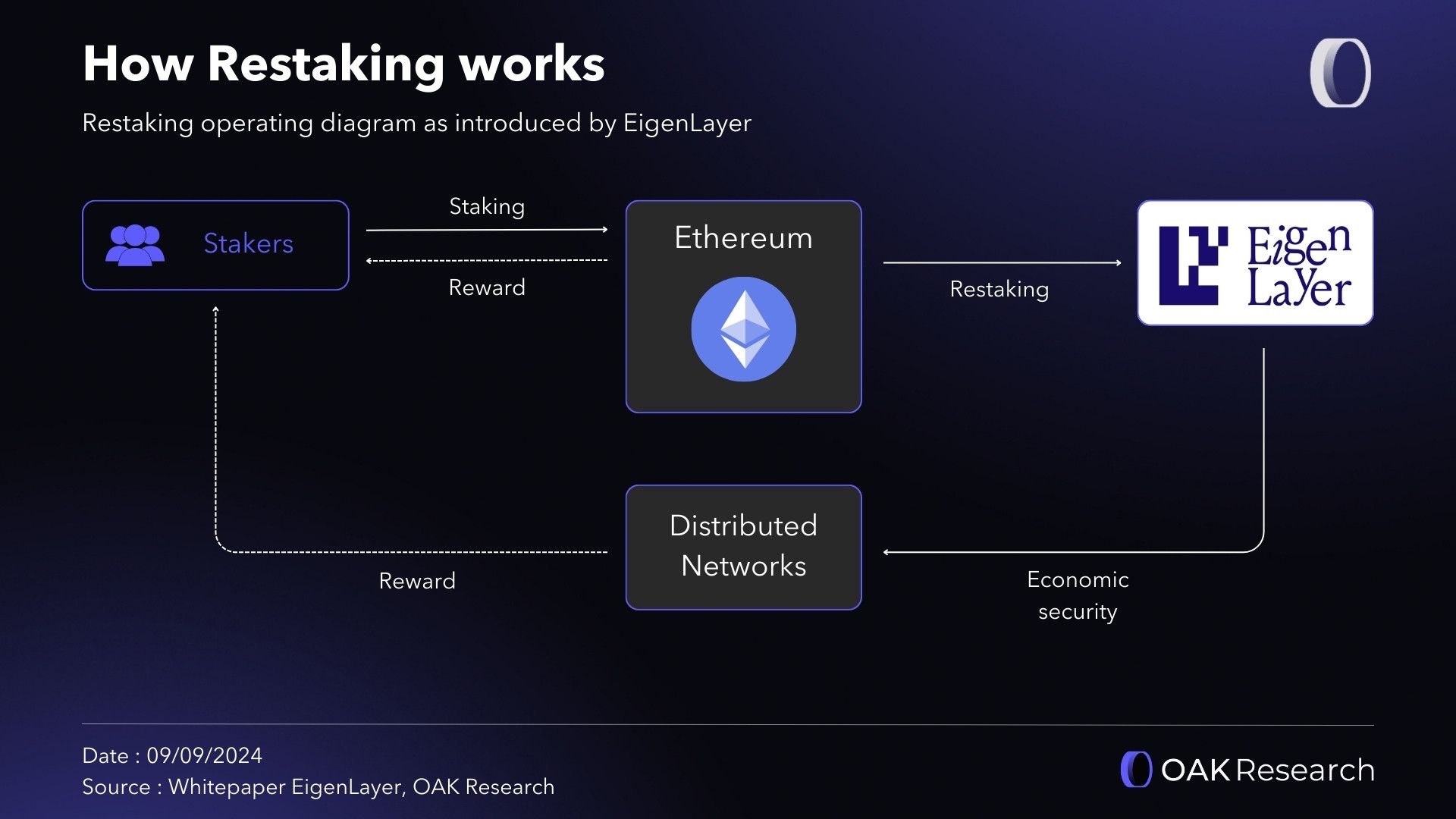
Strategically, EigenDA’s dual quorum system – blending ETH restakers and rollup stakers – fortifies defenses against attacks. It’s a calculated bet on Ethereum’s dominance, ideal for projects unwilling to dilute their security posture.
Celestia: Modular Sovereignty Through Data Availability Sampling
Celestia carves a different path as a dedicated DA blockchain, wielding Data Availability Sampling to empower light nodes in verifying massive blocks efficiently. Current 8MB blocks every 6 seconds pave the way for 1GB ambitions, dubbing it ‘fiber-optic’ blockspace. This appeals to rollups craving independence from Ethereum’s orbit.
Fraud proofs underpin Celestia’s model, enforcing a challenge window that prioritizes verifiable decentralization over instant attestations. Real-world wins, like Eclipse slashing DA costs to $0.07 per MB – 55x cheaper than Ethereum blobs – underscore its economic edge. For multi-chain visions, Celestia’s interoperability shines, fostering rollup networks that transcend Ethereum silos.

Key is: an all-knowing, all-powerful god who perfectly aligns with human desires simply does not exist. So Teyvat need out of illusions, humanity must rely on themselves.
they have their own path to walk.
“A drifting star that even the “fortune” that wove the “world” could not imprison.
To the master of the cage, a path with no design has always been inexcusable folly.” https://t.co/cSnxkYlNWu

Celestia’s PoS consensus invites broader participation, trading Ethereum’s battle-tested validators for a fresh, scalable paradigm. It’s the choice for forward-thinking builders plotting cross-ecosystem liquidity flows.
Core Trade-offs: Throughput, Costs, and Security in Focus
When pitting EigenDA vs Celestia for Ethereum L2 rollups, metrics reveal nuanced battle lines. EigenDA scales linearly with operators, suiting high-volume Ethereum apps, while Celestia’s DAS unlocks horizontal scaling across chains.
EigenDA vs Celestia: Key Comparison for Ethereum L2 Rollups
| Metric | EigenDA | Celestia |
|---|---|---|
| Throughput | 100 MB/s (V2) | 8 MB every 6s (scaling to 1 GB blocks) |
| Cost | Ethereum-aligned | $0.07/MB |
| Security | Restaking dual quorum | Fraud proofs PoS |
| Finality | Instant via DAC | Challenge window |
Cost dynamics tilt toward Celestia for budget-conscious rollups, yet EigenDA’s Ethereum integration minimizes vendor risk. Security-wise, restaking offers familiarity, but Celestia’s decentralized proofs challenge the status quo. Developers must weigh ecosystem lock-in against modular flexibility.
These foundational differences set the stage for deeper dives into interoperability and future roadmaps, where strategic alignment will crown the victor for your rollup stack.
Interoperability emerges as a battleground where Celestia’s modular design pulls ahead for rollups envisioning cross-chain futures. Its namespace architecture lets multiple rollups share blockspace seamlessly, enabling atomic composability across ecosystems. EigenDA, tethered to Ethereum via restaking, excels in unified liquidity pools but risks silos if Ethereum’s dominance wanes. For L2s like Base or zkSync eyeing Solana bridges, Celestia’s agnostic stance offers strategic flexibility; Ethereum purists stick with EigenDA’s seamless sequencer integration.
Token Economics and Market Momentum in the DA Race
Behind the tech, token incentives shape adoption trajectories. Celestia’s TIA fuels its PoS network, with low DA costs driving rollup migrations and boosting demand. EigenDA rides EigenLayer’s EIGEN restaking wave, where operator rewards align with Ethereum’s yield farming culture. As L2 TVL surges past $50 billion in 2026, DA layers capturing even 10% market share could see explosive growth. Budget-savvy projects flock to Celestia’s $0.07 per MB pricing, while EigenDA’s premium throughput justifies costs for high-stakes DeFi rollups.
Celestia TIA vs EigenLayer EIGEN: Token performance, TVL growth, and DA adoption metrics for Ethereum L2 strategies
| Metric | Celestia (TIA) | EigenLayer (EIGEN) |
|---|---|---|
| Token Utility | Purpose-built DA & consensus blockchain for rollups | Restaking AVS providing DA leveraging Ethereum security |
| TVL Growth Driver | Rapid rollup adoption (e.g., Eclipse switch for cost savings) | Restaking integration with Ethereum ecosystem |
| DA Throughput | 8 MB blocks / 6s (~1.33 MB/s current; 1 GB planned ~167 MB/s) | Up to 100 MB/s (V2) |
| DA Cost per MB | $0.07 (Eclipse example, 55x cheaper than Ethereum blobs) | Not specified; Ethereum-aligned |
| Verification Method | Data Availability Sampling (DAS) for light nodes | KZG commitments (no full download needed) |
| Security Model | PoS consensus with fraud proofs | Dual Quorum: ETH restakers + rollup-native stakers |
| Finality | Fraud proofs with challenge window | DAC attestations via operators |
| Primary Strength for L2s | Cost-efficiency & multi-chain modularity | High throughput & Ethereum security alignment |
| Adoption Status | Growing in L2s seeking sovereignty (e.g., Eclipse) | Ideal for high-volume Ethereum rollups |
This economic divergence underscores a core strategic fork: Celestia rewards volume-driven scalability, EigenDA premiums Ethereum loyalty with compounded security yields.
2026 Roadmaps: Throughput Leaps and Danksharding Shadows
Looking ahead, both DA layers eye aggressive scaling. EigenDA’s V3 promises operator sharding for sub-second latencies, pushing beyond 100MB/s while deepening restaking quorums. Celestia targets 1GB blocks via DAS optimizations, positioning as the ‘fiber-optic’ backbone for 100 and rollups. Yet Ethereum’s Fusaka upgrade looms, blending native blobs with modular options and potentially commoditizing DA. Celestia projected to dominate non-Ethereum rollups, per MEXC forecasts, while EigenDA cements Ethereum L2 supremacy.
Celestia Technical Analysis Chart
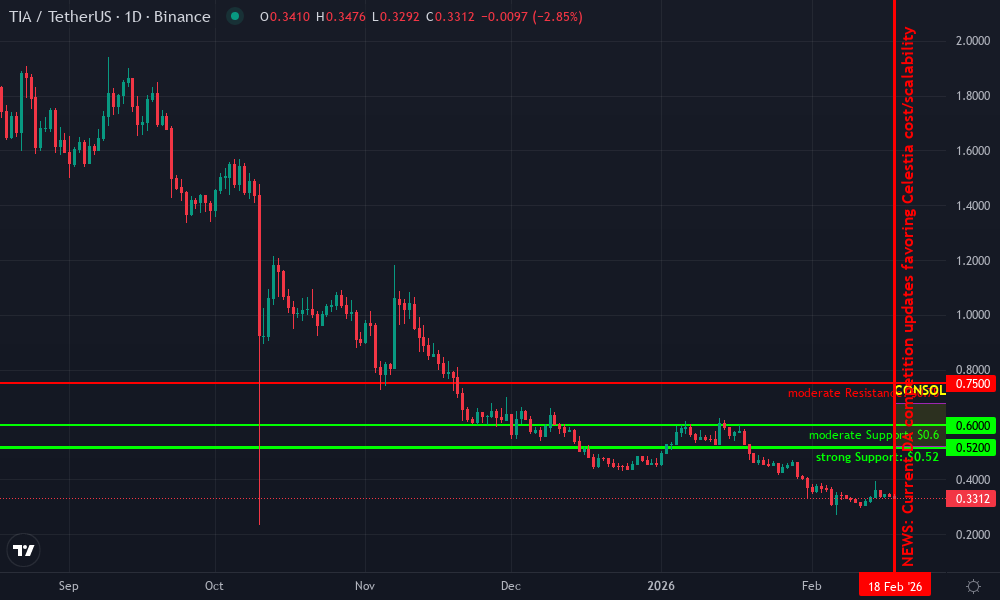
Analysis by Market Analyst | Symbol: BINANCE:TIAUSDT | Interval: 1D | Drawings: 7
Technical Analysis Summary
To annotate this Celestia (TIAUSDT) chart effectively in my balanced technical style, start by drawing a prominent downtrend line from the October 2026 peak around 2.10 USDT (approx. 2026-10-10) connecting to the December 2026 low near 0.52 USDT (approx. 2026-12-15), with moderate confidence. Add horizontal support at 0.52 USDT (strong, recent multiple tests) and resistance levels at 0.75 USDT (moderate) and 1.00 USDT (weak, prior breakdown). Mark the ongoing consolidation rectangle from late December 2026 to mid-February 2026 between 0.52-0.68 USDT. Use arrow markers for volume spike on the November drop and current low volume callout. Draw MACD bearish crossover arrow down in November, now flat. Suggest long entry zone at 0.55 USDT with stop below 0.50 and target 0.85 USDT. Vertical line at 2026-02-18 for current date. Text notes for accumulation phase amid DA competition narrative.
Risk Assessment: medium
Analysis: Post-crash basing with low volume, but crypto volatility and DA competition risks; medium tolerance suits waiting for confirmation
Market Analyst’s Recommendation: Hold for breakout above 0.70 or enter long at support with tight stops; monitor L2 adoption news
Key Support & Resistance Levels
📈 Support Levels:
-
$0.52 – Strong multi-test low from Dec-Jan, capitulation zone
strong -
$0.6 – Recent swing low, minor support
moderate
📉 Resistance Levels:
-
$0.75 – Consolidation high, prior resistance
moderate -
$1 – Psych round number, Nov breakdown level
weak
Trading Zones (medium risk tolerance)
🎯 Entry Zones:
-
$0.55 – Bounce from strong support in low volume accumulation, aligns with Celestia DA edge narrative
medium risk -
$0.62 – Break above recent high for confirmation
low risk
🚪 Exit Zones:
-
$0.85 – Measured move from consolidation range, initial PT
💰 profit target -
$0.48 – Below strong support invalidates basing
🛡️ stop loss
Technical Indicators Analysis
📊 Volume Analysis:
Pattern: decreasing after spike
High volume on Nov drop (capitulation), now low/drying up signaling potential reversal
📈 MACD Analysis:
Signal: bearish crossover flattening
MACD crossed bearish in Nov drop, histogram contracting near zero, watch for bullish divergence
Applied TradingView Drawing Utilities
This chart analysis utilizes the following professional drawing tools:
Disclaimer: This technical analysis by Market Analyst is for educational purposes only and should not be considered as financial advice.
Trading involves risk, and you should always do your own research before making investment decisions.
Past performance does not guarantee future results. The analysis reflects the author’s personal methodology and risk tolerance (medium).
Avail and NearDA lurk as wildcards, but for Ethereum L2s, this duo leads. EigenDA’s roadmap bets on restaking centralization efficiencies; Celestia’s on decentralized sampling revolutions.
Real-world adoptions crystallize these paths. Eclipse’s Celestia pivot slashed costs 55-fold, igniting a wave of Solana-Ethereum hybrids. Meanwhile, EigenDA powers Mantle and Scroll, delivering 15MB/s live throughput with Ethereum finality. BlockEden data highlights Celestia’s edge in cost-per-tx, yet EigenDA’s 99.9% uptime sways risk-averse teams. By mid-2026, expect 40% of new L2s to split evenly, per Eclipse Labs analysis, with hybrids emerging via multi-DA strategies.
Strategic Framework: Picking Your DA Ally
For Ethereum L2 architects, alignment trumps absolutes. Prioritize EigenDA if your rollup thrives on ETH restaking yields, demands instant DAC attestations, and scales vertically within OP Stack ecosystems. Its dual quorum shields against 51% threats better than fraud-proof delays, ideal for $10B and TVL behemoths.
- High-throughput DeFi: EigenDA’s linear operator scaling dominates.
- Cross-chain gaming/social: Celestia’s DAS and namespaces enable fluid interoperability.
- Cost hawks: Celestia at $0.07/MB crushes Ethereum blobs.
Hybrid pilots, like Celestia DA with EigenLayer validity, hint at convergence. Test via devnets: deploy a sample rollup batch to gauge latency and fees. In this data availability layers Ethereum L2 arena, victory favors the aligned – Ethereum loyalists to EigenDA, modular visionaries to Celestia. Your stack’s 2026 scalability hinges on this precision choice.
About the Author