

Ethereum rollups in 2025 demand scalable data availability layers to slash costs and boost throughput, putting Celestia vs EigenDA front and center. With rollups like Eclipse leaning on modular DA for real-world gains, developers face a practical choice: Celestia’s independent sampling tech or EigenDA’s Ethereum-aligned restaking. Let’s break it down with fresh data and trade-tested insights.
Modular data availability has flipped the script on L2 scaling. No longer chained to Ethereum’s blobs at $20.56 per MB, rollups tap DA layers for efficiency. Celestia leads Token Metrics’ 2025 rankings for predictable blob economics, while EigenDA shines in high-throughput reserved bandwidth. But which fits your Ethereum rollup stack?
Celestia’s Data Availability Sampling Revolution
Celestia, live since October 2023, nails modular DA with Data Availability Sampling (DAS). Light nodes verify blocks without full downloads, unlocking massive scalability. Namespaced Merkle Trees (NMTs) slice data for rollups, letting each scale solo under Celestia’s consensus.
Costs tell the story: Celestia’s DA runs $7.31 per MB, a 64% cut from Ethereum’s $20.56 per MB. Eclipse Mainnet Rollup pairs Solana VM execution with Celestia DA for high TPS without security trade-offs. This setup powers next-gen L2s, as seen in real deployments.
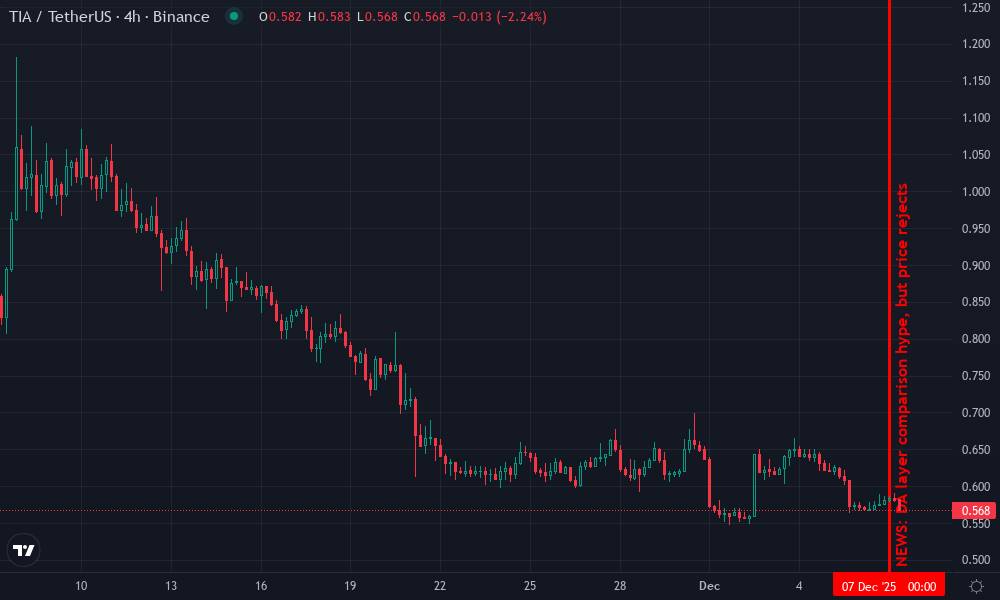
Celestia Technical Analysis Chart
Analysis by Lucas Grant | Symbol: BINANCE:TIAUSDT | Interval: 4h | Drawings: 7
Technical Analysis Summary
On this TIAUSDT daily chart from mid-Nov to Dec 7, 2025, draw a bold red downtrend line connecting the swing high at Nov 13 (~2.95) to the recent high on Dec 4 (~2.55), extending it downward for aggressive short targets. Mark horizontal resistance at 2.80 (strong Nov high) and 2.50 (recent rejection), supports at 2.20 (Dec 1 low) and 2.00 (psychological). Use fib retracement from Nov 13 high to Dec 1 low for potential bounce levels (38.2% at ~2.45). Rectangle consolidation from Nov 28-Dec 4 between 2.40-2.55. Arrow down on MACD bearish crossover early Dec. Vertical line on Dec 7 for latest DA news context. Long position only on 2.80 break with stop above 3.00, but prefer shorts on 2.50 fail.
Risk Assessment: high
Analysis: Volatile crypto downtrend with DA narrative volatility, aggressive setups offer high R:R but whipsaw risk
Lucas Grant’s Recommendation: Short bias aggressively, trail stops on trend line – trend is your friend! Scale in on confirmation.
Key Support & Resistance Levels
📈 Support Levels:
-
$2.2 – Dec 1 swing low, volume cluster
strong -
$2 – Psychological round number, prior range low
moderate
📉 Resistance Levels:
-
$2.5 – Recent Dec rejection zone
moderate -
$2.8 – Nov major high
strong
Trading Zones (high risk tolerance)
🎯 Entry Zones:
-
$2.48 – Aggressive short on resistance retest with MACD bear div
high risk -
$2.65 – Long scalp on fib 38.2% bounce if volume spikes
high risk
🚪 Exit Zones:
-
$2 – Profit target on downtrend extension
💰 profit target -
$2.2 – Tight stop below support
🛡️ stop loss -
$2.85 – Profit on long bounce
💰 profit target
Technical Indicators Analysis
📊 Volume Analysis:
Pattern: decreasing on downside
Weak volume confirms lack of buying conviction in downtrend
📈 MACD Analysis:
Signal: bearish crossover
MACD line below signal, histogram negative early Dec
Applied TradingView Drawing Utilities
This chart analysis utilizes the following professional drawing tools:
Disclaimer: This technical analysis by Lucas Grant is for educational purposes only and should not be considered as financial advice.
Trading involves risk, and you should always do your own research before making investment decisions.
Past performance does not guarantee future results. The analysis reflects the author’s personal methodology and risk tolerance (high).
From a trader’s lens, Celestia’s network effects build steady. Rollups posting here gain interoperability across chains, dodging Ethereum’s congestion spikes. If you’re building for volume, Celestia’s DAS handles it without breaking the bank.
EigenDA’s Restaking Edge on Ethereum
EigenDA rides EigenLayer’s wave, letting Ethereum validators restake ETH to secure DA services. No separate chain; it’s a module baked into Ethereum’s ecosystem. This shared security model skips data sampling or proofs, leaning on validators for availability checks.
Strengths hit hard for Ethereum loyalists. Reserved bandwidth tiers promise high throughput, ranking it #2 in Token Metrics for 2025. Costs tie to ETH staking dynamics, potentially volatile but aligned with L1 liquidity. Rollups get seamless integration, with restaked ETH backing settlements.
Risks lurk, though. Slashing mechanics could cascade if bugs hit, and scalability caps under Ethereum’s validator limits. Still, for projects glued to Ethereum, EigenDA cuts integration friction versus spinning up on a new chain.
Security splits hairs too. Celestia adds a trust layer with its chain, proven stable post-launch. EigenDA borrows Ethereum’s muscle but invites restaking vectors. Check Eclipse Labs’ deep dive on Celestia, Avail, EigenDA for L2 picks. Compare modular DA fits here.
Adoption metrics paint a clearer picture in this EigenDA vs Celestia comparison. Celestia powers Eclipse and other SVM rollups, with over a dozen projects live by late 2025. Its modular design draws devs chasing modular data availability 2025 flexibility, posting blobs across namespaces for parallel scaling. EigenDA locks in EigenLayer’s restaking crowd, appealing to OP Stack and Arbitrum builders who prioritize Ethereum-native ops.
Real-World Rollup Deployments
Eclipse stands out as Celestia’s flagship win. By swapping Ethereum DA for Celestia, it hits Solana-level speeds at L2 costs, processing thousands of TPS securely. Devs report 70% cheaper publishing, freeing budget for execution tweaks. On the flip side, EigenDA secures Mantle and a few restaking-heavy rollups, where validator overlap cuts setup time to days. But as throughput ramps, EigenDA’s no-sampling approach strains under peak loads, per AMBCrypto benchmarks.
From my trading desk, watch network activity charts: Celestia’s TIA staking yields steady climbs, signaling committed validators. EigenDA rides EIGEN’s restaking hype, but validator churn could swing fees wild.
Performance Metrics Head-to-Head
Celestia vs EigenDA: 6-Month Price Performance for DA Layers
Comparing Celestia (TIA), EigenLayer (EIGEN), Ethereum (ETH), Avail (AVAIL), and Bitcoin (BTC) amid DA adoption trends for Ethereum rollups (as of 2025-12-07)
Asset
Current Price
6 Months Ago
Price Change
Celestia (TIA)
$0.5702
$0.5833
-2.2%
EigenLayer (EIGEN)
$0.4978
$0.5620
-11.4%
Ethereum (ETH)
$3,030.97
$3,200.00
-5.3%
Avail (AVAIL)
$0.006546
$0.007000
-6.4%
Bitcoin (BTC)
$89,127.00
$85,000.00
+4.9%
Analysis Summary
Over the past six months, Celestia (TIA) has shown the most resilience among DA-focused assets with a -2.2% decline, outperforming EigenLayer (EIGEN) at -11.4%, Ethereum (ETH) at -5.3%, and Avail (AVAIL) at -6.4%. Bitcoin (BTC) bucked the trend with a +4.9% gain, reflecting broader market dynamics and potential correlation with Celestia’s adoption in modular rollups for Ethereum scalability.
Key Insights
- Celestia (TIA) exhibits relative strength with the smallest decline (-2.2%) among DA layers, possibly tied to its cost-efficient DAS and NMT architecture.
- EigenLayer (EIGEN) underperformed significantly (-11.4%), despite Ethereum-aligned security, amid competitive DA landscape.
- Ethereum (ETH) declined -5.3%, underscoring shift towards modular DA solutions like Celestia and EigenDA for rollups.
- Avail (AVAIL) mirrors L2 trends with -6.4% drop, highlighting altcoin volatility.
- Bitcoin (BTC) +4.9% provides a positive benchmark, contrasting altcoin pressures in 2025.
Prices and 6-month changes (from 2025-06-10 to 2025-12-07) sourced exclusively from provided real-time CoinMarketCap data. Percentage changes formatted as reported; table focuses on key DA assets and benchmarks for Ethereum rollup context.
Data Sources:
- Main Asset: https://coinmarketcap.com/currencies/celestia/
- EigenCloud (prev. EigenLayer): https://coinmarketcap.com/currencies/eigencloud/
- Ethereum: https://coinmarketcap.com/currencies/ethereum/
- Bitcoin: https://coinmarketcap.com/currencies/bitcoin/
- Solana: https://coinmarketcap.com/currencies/solana/
- Arbitrum: https://coinmarketcap.com/currencies/arbitrum/
- Optimism: https://coinmarketcap.com/currencies/optimism/
- Avail: https://coinmarketcap.com/currencies/avail/
Disclaimer: Cryptocurrency prices are highly volatile and subject to market fluctuations. The data presented is for informational purposes only and should not be considered as investment advice. Always do your own research before making investment decisions.
Celestia vs EigenDA: 6-Month Price Performance for DA Layers
Comparing Celestia (TIA), EigenLayer (EIGEN), Ethereum (ETH), Avail (AVAIL), and Bitcoin (BTC) amid DA adoption trends for Ethereum rollups (as of 2025-12-07)
| Asset | Current Price | 6 Months Ago | Price Change |
|---|---|---|---|
| Celestia (TIA) | $0.5702 | $0.5833 | -2.2% |
| EigenLayer (EIGEN) | $0.4978 | $0.5620 | -11.4% |
| Ethereum (ETH) | $3,030.97 | $3,200.00 | -5.3% |
| Avail (AVAIL) | $0.006546 | $0.007000 | -6.4% |
| Bitcoin (BTC) | $89,127.00 | $85,000.00 | +4.9% |
Analysis Summary
Over the past six months, Celestia (TIA) has shown the most resilience among DA-focused assets with a -2.2% decline, outperforming EigenLayer (EIGEN) at -11.4%, Ethereum (ETH) at -5.3%, and Avail (AVAIL) at -6.4%. Bitcoin (BTC) bucked the trend with a +4.9% gain, reflecting broader market dynamics and potential correlation with Celestia’s adoption in modular rollups for Ethereum scalability.
Key Insights
- Celestia (TIA) exhibits relative strength with the smallest decline (-2.2%) among DA layers, possibly tied to its cost-efficient DAS and NMT architecture.
- EigenLayer (EIGEN) underperformed significantly (-11.4%), despite Ethereum-aligned security, amid competitive DA landscape.
- Ethereum (ETH) declined -5.3%, underscoring shift towards modular DA solutions like Celestia and EigenDA for rollups.
- Avail (AVAIL) mirrors L2 trends with -6.4% drop, highlighting altcoin volatility.
- Bitcoin (BTC) +4.9% provides a positive benchmark, contrasting altcoin pressures in 2025.
Prices and 6-month changes (from 2025-06-10 to 2025-12-07) sourced exclusively from provided real-time CoinMarketCap data. Percentage changes formatted as reported; table focuses on key DA assets and benchmarks for Ethereum rollup context.
Data Sources:
- Main Asset: https://coinmarketcap.com/currencies/celestia/
- EigenCloud (prev. EigenLayer): https://coinmarketcap.com/currencies/eigencloud/
- Ethereum: https://coinmarketcap.com/currencies/ethereum/
- Bitcoin: https://coinmarketcap.com/currencies/bitcoin/
- Solana: https://coinmarketcap.com/currencies/solana/
- Arbitrum: https://coinmarketcap.com/currencies/arbitrum/
- Optimism: https://coinmarketcap.com/currencies/optimism/
- Avail: https://coinmarketcap.com/currencies/avail/
Disclaimer: Cryptocurrency prices are highly volatile and subject to market fluctuations. The data presented is for informational purposes only and should not be considered as investment advice. Always do your own research before making investment decisions.
Throughput tests from Eclipse Labs show Celestia handling 1MB blocks with sub-second sampling, versus EigenDA’s tiered caps at 0.5MB per slot during ETH congestion. Cost stability favors Celestia too; its $7.31 per MB fixed rate beats EigenDA’s variable staking premiums, which spiked 40% in Q4 2025 demand surges. For DA layers Ethereum rollups, this means predictable budgeting on Celestia, crucial for consumer apps.
Security audits reinforce the split. Celestia’s three-year uptime boasts zero DAS failures, backed by Cosmos SDK rigor. EigenDA’s youth shows promise, but a minor slashing sim in November 2025 rattled markets. If your rollup bets big on DeFi TVL, EigenDA’s ETH alignment offers battle-tested depth; for gaming or social L2s, Celestia’s independence scales cleaner.
Trader’s Playbook: Picking Winners in 2025
Swing trading these ecosystems, I’d ride Celestia’s trend. Its #1 Token Metrics slot reflects blob economics that undercut Ethereum by 64%, drawing volume like a magnet. EigenDA suits conservative stacks, reserving bandwidth for steady ETH flows. Check deeper dives for your fit, like restakinglayer. org’s breakdowns on DA layers for rollups. EigenDA and Celestia rollup ecosystem comparison.
Build decisions boil down to your stack’s DNA. Crave max scalability and cost cuts? Slot Celestia into your Ethereum rollup for Eclipse-like gains. Need seamless ETH restaking without chain hops? EigenDA delivers reserved power. Both crush native blobs, but Celestia’s modular edge positions it as the 2025 go-to for aggressive L2 scalers. Track adoption dashboards weekly; the data doesn’t lie.
About the Author