

Ethereum rollups have transformed scalability, but data availability remains the stubborn bottleneck holding them back. As transaction volumes swell, posting all that data on Ethereum’s Layer 1 becomes prohibitively expensive and slow. Enter modular solutions like Celestia DA sampling and EigenLayer data availability, each promising to unshackle rollups from these chains. Celestia pioneers a blockchain-agnostic path with its data availability sampling, while EigenLayer doubles down on Ethereum’s restaking revolution. For builders eyeing Ethereum rollups DA, choosing between these DA solutions scalability contenders boils down to modularity versus native integration.

Celestia shattered the mold as the first to cleanly separate data availability from execution and consensus. This modular blueprint lets rollups offload data to Celestia, slashing costs by up to 100x according to Zeeve research. Light nodes don’t need the full block; they sample tiny chunks to verify availability probabilistically. It’s elegant, scalable, and draws from decades of cryptographic theory. Yet skeptics point to the challenge window for fraud proofs, which introduces a finality delay Ethereum purists might balk at.
Celestia’s Data Availability Sampling: Scalability Without Compromise
At its core, Celestia DA sampling empowers light clients to check massive blocks with minimal bandwidth. Imagine verifying a 1MB block by downloading just 100 bytes; that’s the magic. Nodes query random Reed-Solomon encoded shares, achieving security through sheer statistical probability. Celestia’s Blobstream bridges it to Ethereum, using light clients to attest data roots on L1. This setup supports not just EVM chains but any rollup flavor, embodying true modular blockchain DA layers.
Celestia was the first network to separate data availability and consensus from execution. This separation gives developers more flexibility. – Lithium Digital
Throughput soars here. Celestia handles megabits per second, far outpacing Ethereum’s blobs. Costs? Pennies per MB. Forums buzz with praise for its security edge over committee-based systems, as Reddit’s r/ethereum threads highlight. DAS feels more decentralized, less reliant on trusted few. For cross-chain ambitions, it’s unmatched.

EigenLayer’s EigenDA: Restaking Meets Data Assurance
EigenLayer flips the script by embedding DA into Ethereum’s ecosystem via restaking. Validators stake ETH twice, securing EigenDA alongside AVS (Actively Validated Services). EigenDA’s Dual Quorum demands nods from both ETH restakers and native operators, fortifying against collusion. KZG commitments let nodes prove data integrity sans full downloads, proactive unlike Celestia’s reactive sampling.
Scalability shines through operator count; more restakers mean linear throughput gains. Tailored for Ethereum rollups, it sidesteps cross-chain friction. Finality? Near-instant, no challenge periods. Blockworks notes Celestia’s hash reliance might lag guarantees, but EigenDA’s operator attestations deliver certainty. Tradeoff: Ethereum-centrism limits broader appeal.
Celestia vs EigenDA – Throughput, Cost, Finality Time, Security Model, Ethereum Integration
| Metric | Celestia | EigenDA |
|---|---|---|
| Throughput | High: DAS enables efficient verification of large blocks without full downloads, drastically increases rollup transaction throughput (up to 100x scaling potential) | High: Scales linearly with number of operators, tailored for Ethereum rollups |
| Cost | Extremely low: Competitive advantage with up to 100x cost reduction for L2 data availability | Moderate: Ethereum restaking-based, less emphasis on extreme cost savings |
| Finality Time | Slower: Fraud-proof system requires challenge period for disputes, potential delays from secure hash functions | Faster: Proactive assurance via KZG commitments and Dual Quorum attestations |
| Security Model | Data Availability Sampling (DAS): Light nodes verify via sampling; considered highly secure and decentralized | Dual Quorum (ETH restakers + rollup-native stakers) with KZG validity proofs; Ethereum-aligned incentives and enhanced security |
| Ethereum Integration | Modular & blockchain-agnostic: Supports Ethereum rollups with broad ecosystem flexibility | Deeply Ethereum-native: Leverages ETH restaking for seamless rollup integration |
Unpacking the Tradeoffs for Rollup Builders
Side by side, Celestia screams modularity. Its agnostic design courts Solana rollups or beyond, per Celestia Forum debates. EigenDA, though, locks in Ethereum loyalty with restaking economics. Nansen calls DA the bedrock for scalable apps; both deliver, but Celestia’s cost edge – touted by MT Capital – tempts cost-conscious teams. Eclipse Labs weighs trust models: Celestia’s sampling probabilistic yet robust, EigenDA’s quorums permissionless but operator-heavy.
Technorely contrasts with Avail’s universality, yet for Ethereum focus, these two dominate. YBB dubs Celestia Ethereum’s DA rival, backed by throughput data. Builders must weigh: crave chain independence or Ethereum synergy? DAS scales horizons wide; EigenDA fortifies home turf.
Real-world metrics underscore these differences. Celestia’s data throughput routinely hits tens of MB per block, enabling rollups to process thousands more transactions affordably. EigenDA, scaling with restaker numbers, promises similar peaks but hinges on Ethereum’s validator growth. Zeeve pegs Celestia’s cost savings at 100x for Layer 2s, a game-changer for high-volume apps like DeFi aggregators or gaming platforms.
Celestia Technical Analysis Chart
Analysis by Market Analyst | Symbol: BINANCE:TIAUSDT | Interval: 1D | Drawings: 6
Technical Analysis Summary
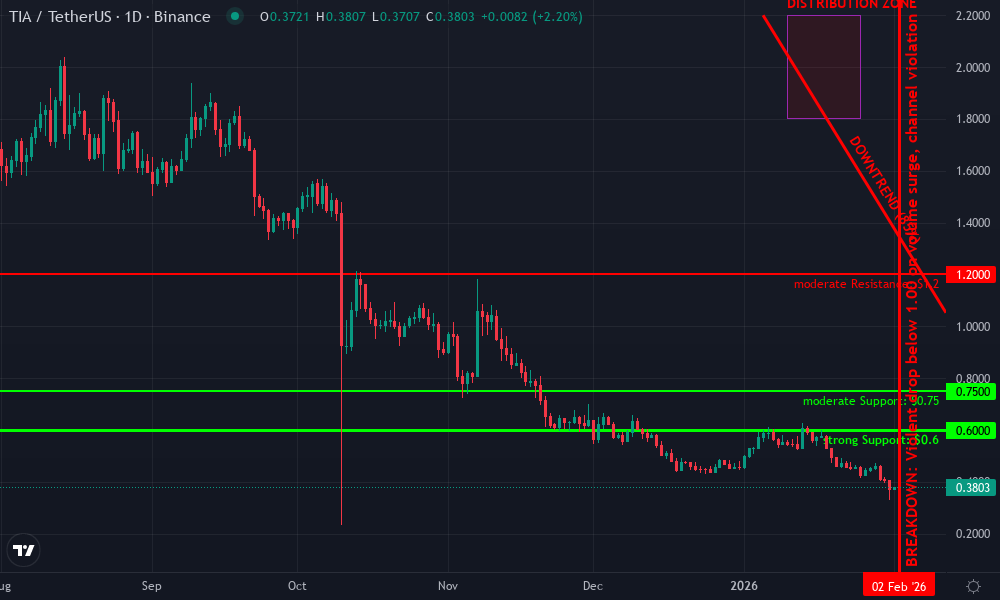
On this Celestia (TIAUSDT) daily chart spanning late 2025 into early 2026, draw a prominent downtrend line connecting the swing high at 2026-01-05 around 2.20 to the recent swing low at 2026-02-18 around 0.62, highlighting the dominant bearish channel. Add horizontal support lines at 0.60 (strong, recent lows), 0.75 (moderate), and resistance at 1.00 (weak, prior consolidation), 1.20 (moderate, failed retest). Use Fibonacci retracement from the major drop: pullback levels at 0.786 (0.85) and 0.618 (0.95) for potential entries. Mark a distribution range rectangle from 2026-01-10 to 2026-01-25 between 1.80-2.20. Place arrow_mark_down at MACD bearish crossover on 2026-01-28, callout on volume spike during breakdown at 2026-02-02 ‘Selling Climax’. Vertical line for breakdown event on 2026-02-02. Entry zone long at 0.65 with stop below 0.60, target 1.00. Overall, balanced view: oversold bounce potential in medium risk setup amid DA competition pressures.
Risk Assessment: medium
Analysis: Strong downtrend but oversold signals and support confluence offer balanced risk/reward for longs; DA competition adds fundamental overhang
Market Analyst’s Recommendation: Consider small long positions at support with tight stops, scale out on resistance tests; avoid if breaks 0.60
Key Support & Resistance Levels
📈 Support Levels:
-
$0.6 – Strong multi-touch low, volume shelf
strong -
$0.75 – Moderate prior swing low retest
moderate
📉 Resistance Levels:
-
$1 – Weak psychological round number, prior support flip
weak -
$1.2 – Moderate channel midline resistance
moderate
Trading Zones (medium risk tolerance)
🎯 Entry Zones:
-
$0.65 – Bounce from strong support with volume divergence, fib 0.786 retrace
medium risk
🚪 Exit Zones:
-
$1 – Initial profit target at resistance flip
💰 profit target -
$0.55 – Below strong support invalidation
🛡️ stop loss
Technical Indicators Analysis
📊 Volume Analysis:
Pattern: climax selling on breakdown with decreasing volume on lows
High volume spike on Feb drop signals exhaustion, low volume chop suggests base building
📈 MACD Analysis:
Signal: bearish crossover followed by histogram contraction
MACD line below signal, but flattening hints at potential bullish divergence
Applied TradingView Drawing Utilities
This chart analysis utilizes the following professional drawing tools:
Disclaimer: This technical analysis by Market Analyst is for educational purposes only and should not be considered as financial advice.
Trading involves risk, and you should always do your own research before making investment decisions.
Past performance does not guarantee future results. The analysis reflects the author’s personal methodology and risk tolerance (medium).
Adoption Trajectories and Ecosystem Momentum
Celestia boasts early mover advantage, powering rollups like Dymension and initiatives beyond Ethereum. Its agnostic stance resonates in a multi-chain world, as Celestia Forum discussions reveal a spectrum of integrations from Cosmos to EVM. EigenLayer, post-mainnet, draws Ethereum die-hards; restaking TVL surges signal strong buy-in for EigenDA. Eclipse Labs notes EigenDA’s edge in finality speed, crucial for time-sensitive trades, while Celestia’s DAS shines in bandwidth-starved environments.
Security models diverge sharply. Reddit threads favor DAS for dodging committees, deeming it more battle-tested against centralization. EigenDA counters with dual quorums, blending ETH’s proven stake with operator diversity. Blockworks flags Celestia’s hash challenges as a minor hitch; in practice, Blobstream light clients mitigate this effectively. Both sidestep Ethereum’s DA bottlenecks, but Celestia’s modularity future-proofs against L1 shifts.

Strategic Fit for Ethereum Rollup Builders
For Ethereum-centric teams, EigenLayer data availability offers seamless synergy. Restaking aligns incentives, leveraging existing ETH liquidity without new tokens. It’s proactive assurance: operators attest availability upfront, slashing dispute risks. Scalability ties directly to Ethereum’s health, ideal if you bet on L1 dominance. Celestia DA sampling, conversely, liberates from such bets. Post data to TIA-secured blocks, verify via samples, and bridge as needed. Cost trumps all for volume-heavy rollups; MT Capital hails Celestia’s pricing as unbeatable.
Consider use cases. High-frequency trading rollups lean EigenDA for sub-second finality. NFT marketplaces or social apps, hungry for cheap storage, flock to Celestia. Nansen positions DA as scalability bedrock; here, Celestia broadens the foundation, EigenDA reinforces it. Builders blending both? Possible via multi-DA strategies, though complexity rises.
EigenDA uses Data Availability Committees whereas Celestia primarily uses Data Availability Sampling. The latter is considered more secure. – r/ethereum
Looking ahead, competition sharpens innovation. Celestia’s roadmap eyes sovereign rollups; EigenLayer expands AVS. As Ethereum blobs evolve post-Dencun, these layers amplify them. Avail lurks universal, per Technorely, but for Ethereum rollups DA today, Celestia and EigenDA lead. My take: diversify proofs. Start Celestia for cost, layer EigenDA for speed. Rollup scalability thrives on such adaptive stacks, mirroring modular blockchain DA layers’ promise. Ethereum builders, equipped with these tools, stand poised to outscale monolithic rivals.
About the Author