

Layer 2 rollups promise to supercharge blockchain scalability by bundling thousands of transactions off-chain and settling them on Layer 1. Yet, a sneaky culprit holds them back: the data availability bottleneck. Without reliable access to all transaction data, anyone can challenge invalid states, but verifying massive datasets slows everything down and spikes costs. Enter modular solutions like those from 0G Labs, which tackle this head-on with innovative separation of storage and publishing.
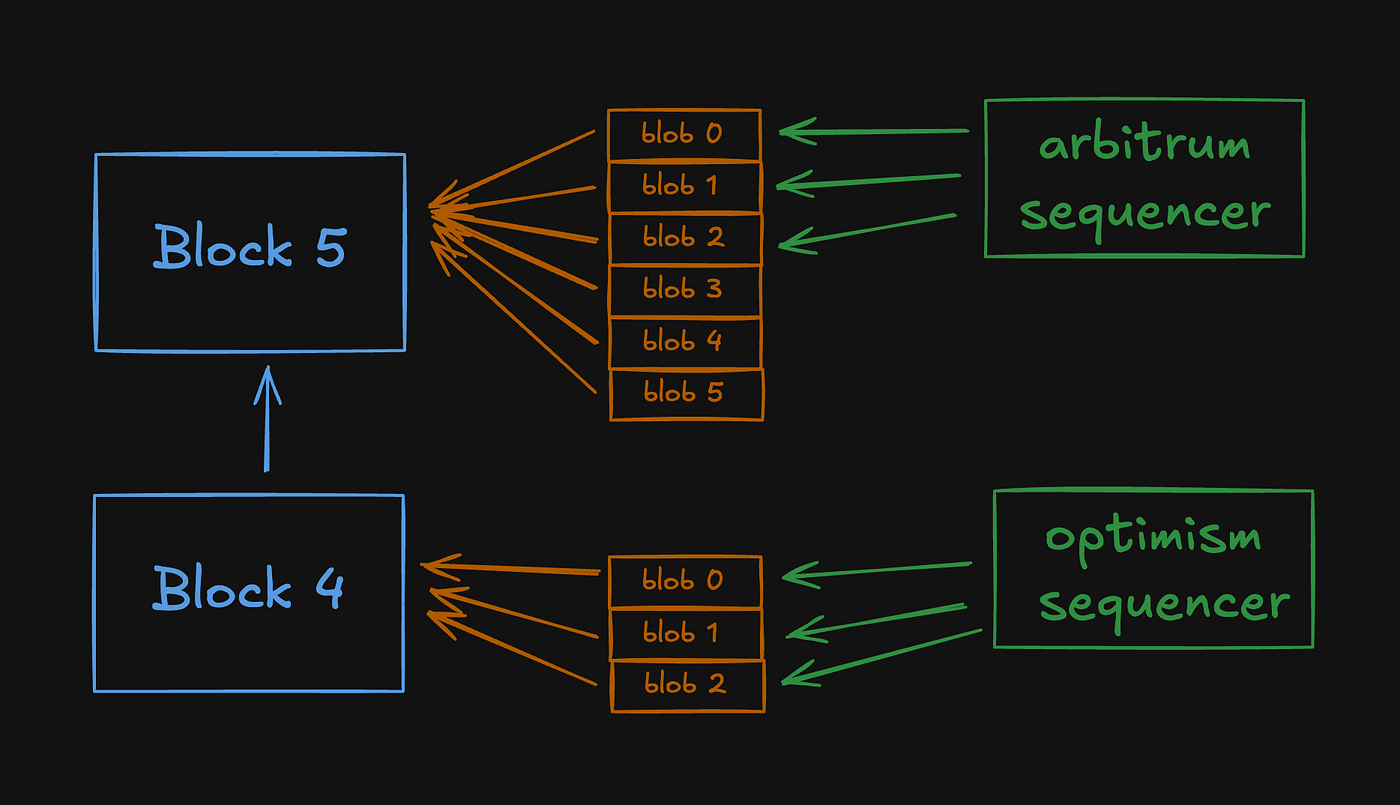
Rollups shine because they inherit Ethereum’s security while slashing fees, but posting full transaction data to the base layer eats up precious block space. This Layer 2 rollups DA crunch means higher costs for users and devs chasing high-throughput dApps. Imagine on-chain AI models or real-time gaming choking on unavailable data; it’s a scalability killer in disguise.
Decoding the Data Availability Crunch in Rollups
At its core, data availability (DA) ensures every node can fetch and check rollup transaction data without trusting a central party. In optimistic rollups, light clients sample data to spot fraud; in ZK-rollups, proofs demand full data access for reconstruction. But Ethereum’s 1-2 MB blocks can’t handle the gigabytes rollups now generate daily. Result? Congested chains, soaring calldata fees, and rollups forced to compress data harshly, risking efficiency.
This data availability bottleneck isn’t abstract; it’s why DeFi volumes hesitate at peaks and AI integrations crawl. Traditional broadcasting every byte works for small scales but crumbles under modular blockchain demands. We need smarter verification without full downloads, and that’s where sampling and erasure coding step up.
Legacy DA Protocols: Hits, Misses, and Scalability Walls
Enter players like Celestia, which mainnet-launched in 2023 to offload DA from rollups. It uses data availability sampling (DAS) so light nodes verify huge blocks via tiny samples, slashing bandwidth needs. Ethereum’s danksharding aims similar with blobs, but both grapple with growth pains: fixed validator sets limit throughput, and storage persistence lags for AI-scale data.
Other blockchain DA solutions like Avail or Near DA broadcast to dedicated chains, but they hit ceilings around 1-10 MB/s. Costs mount as data balloons, and integration friction slows adoption for Polygon or Manta-like networks. Here’s a snapshot:
Comparison of Data Availability Solutions: Celestia, Avail, Near DA vs 0G Labs
| Solution | Throughput (Gbps) | Scalability Method | Cost Efficiency | AI Support |
|---|---|---|---|---|
| Celestia | 1 | Erasure Coding & DAS | Medium | Limited |
| Avail | 0.5 | KZG Commitments & Sampling | Medium | No |
| Near DA | 2 | Sharding | High | Limited |
| 0G Labs | 50 🚀 | Modular DA + Storage (DAS, Erasure Coding) | Very High 💰 | Native ✅ |
These setups evolved DA from naive broadcasting to erasure-coded modular designs with parallel validation. Still, none fully nails infinite scalability or seamless storage for unstructured AI artifacts. Rollups pay the price in throttled performance.
0G Labs Enters the Arena: A Dual-Lane Modular Powerhouse
0G Labs flips the script with its 0G labs DA layer, a beast built for the AI x Web3 era. Forget monolithic DA; they split it into Data Storage Lane and Data Publishing Lane, leveraging 0G Storage’s general-purpose power. Storage uses erasure coding for redundant, horizontally scalable persistence, handling structured tx data or massive unstructured models with real-time access and audit-proof logs.
Publishing? Pure DAS magic lets light nodes sample for verification, confirming availability sans full downloads. Integrated with 0G Consensus, it verifies DA efficiently while dumping persistence to Storage. Testnet Galileo clocked 50 Gbps throughput, dwarfing rivals and unlocking Web2-like speeds for modular data availability.
This duo empowers high-frequency DeFi, on-chain gaming, and compute-heavy AI without base-layer strain. 0G integrates smoothly with L1/L2 like Polygon, boosting their DA and storage. Backed by $35M from Hack VC, Delphi Digital, and others in March 2024, it’s no hype; it’s battle-tested infrastructure.
Developers building on Polygon or Manta can plug straight into 0G’s lanes, offloading DA without rewriting core logic. This modular data availability means rollups post compressed commitments to 0G DA, fetch full data on demand, and store blobs indefinitely in 0G Storage. No more calldata wars on Ethereum; just seamless scaling.
Why 0G Crushes Legacy DA in Rollup Deployments
Legacy protocols shine in theory but falter in practice. Celestia’s DAS caps at lower throughputs because its validator economics tie bandwidth to stake, creating natural limits. Avail broadcasts statically, ignoring dynamic AI loads. Near DA prioritizes speed over persistence, leaving gaps for stateful apps. 0G? It fuses infinite horizontal scaling with AI-optimized storage, hitting 50 Gbps on Galileo Testnet while keeping costs under a cent per GB.
Detailed Throughput and Cost Comparison: 0G Labs vs. Celestia vs. Avail
| Metric | 0G Labs | Celestia | Avail |
|---|---|---|---|
| Throughput | 50 Gbps (Galileo Testnet) | 1-5 Gbps | 2 Gbps |
| Cost per GB | <1¢/GB | 5-10¢/GB | Variable |
| Core Technologies | DAS + Erasure Coding | DAS | KZG Commitments |
| Primary Focus | AI-ready, Modular DA + Storage | Rollup-focused | Basic Persistence |
| Key Advantages | High-throughput for AI/dApps, Horizontal Scalability, $35M Funding (Mar 2024) | Simplified Rollup Deployment | Efficient Commitments |
That table underscores 0G’s edge: not just faster, but smarter for Layer 2 rollups DA. Erasure coding shards data across nodes with minimal redundancy overhead, rebuilding from any fraction. DAS lets even mobile light clients verify 1TB blocks with kilobytes of samples. Consensus layer ties it all, proving availability before rollups settle states.
Real talk: in high-stakes DeFi, unavailable data equals slashed positions or frozen funds. 0G eliminates that risk, enabling sub-second finality for gaming loops or AI inference chains. Picture a rollup handling 100k TPS for prediction markets; without 0G, it’s a pipe dream.
Galileo Testnet Glory: Proof in the Blockchain
Galileo didn’t just hit numbers; it stress-tested the full stack. Under simulated AI workloads, 0G Storage persisted 10TB datasets with 99.99% uptime, retrieval latencies under 100ms. Rollup simulators posted 1M tx blocks, verified by 1,000 light nodes in parallel. Bandwidth peaked at 50 Gbps aggregate, with per-node loads balancing dynamically via stake-weighted sharding.
Compare to Ethereum blobs: post-Dencun, they’re cheap but ephemeral and capped. 0G offers permanence plus speed, perfect for dApps evolving into AI powerhouses. Funding from Stanford Builders and GSR signals VCs betting big on this blockchain DA solutions pivot.
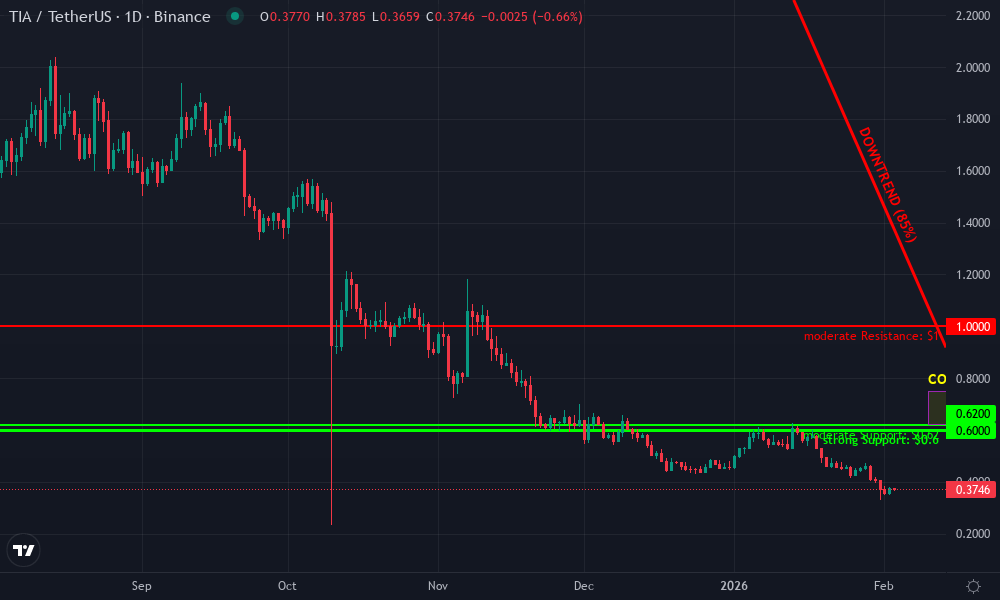
Celestia Technical Analysis Chart
Analysis by Market Analyst | Symbol: BINANCE:TIAUSDT | Interval: 1D | Drawings: 5
Technical Analysis Summary
Draw a prominent downtrend line connecting the swing high near 2026-01-10 at $2.40 to the recent low at 2026-02-20 at $0.65, using a thick red trend_line to highlight the dominant bearish channel. Add horizontal_lines at key support $0.600 (strong) and resistance $1.000 (moderate), $1.500 (weak). Mark a consolidation rectangle from 2026-02-10 to 2026-02-28 between $0.620 and $0.750. Place arrow_mark_down at the breakdown from $1.200 around 2026-01-25. Use callouts for volume drying up and MACD bearish crossover. Fib retracement from high to low for potential bounce levels at 23.6% ($1.05), 38.2% ($1.25).
Risk Assessment: medium
Analysis: Bearish trend intact but oversold conditions and volume fade suggest possible short-term bounce; medium risk aligns with waiting for confirmation
Market Analyst’s Recommendation: Hold off on new positions, monitor for bullish price-volume confirmation above $0.75 before considering longs with tight risk management
Key Support & Resistance Levels
📈 Support Levels:
-
$0.6 – Recent swing low with volume spike, potential capitulation level
strong -
$0.62 – Minor intraday lows holding in recent sessions
moderate
📉 Resistance Levels:
-
$1 – Previous consolidation base before breakdown
moderate -
$1.5 – Mid-channel retracement level, prior support turned resistance
weak
Trading Zones (medium risk tolerance)
🎯 Entry Zones:
-
$0.68 – Bounce from strong support $0.60 with volume increase, potential higher low formation
medium risk -
$0.75 – Breakout above recent range high confirming reversal
low risk
🚪 Exit Zones:
-
$1.2 – 38.2% fib retracement and channel midline
💰 profit target -
$0.58 – Below strong support invalidates long setup
🛡️ stop loss
Technical Indicators Analysis
📊 Volume Analysis:
Pattern: decreasing on downside
High volume on initial drop, now drying up indicating selling exhaustion
📈 MACD Analysis:
Signal: bearish crossover with weakening momentum
MACD line below signal, histogram contracting—watch for bullish divergence
Applied TradingView Drawing Utilities
This chart analysis utilizes the following professional drawing tools:
Disclaimer: This technical analysis by Market Analyst is for educational purposes only and should not be considered as financial advice.
Trading involves risk, and you should always do your own research before making investment decisions.
Past performance does not guarantee future results. The analysis reflects the author’s personal methodology and risk tolerance (medium).
Zoom out, and 0G positions rollups as true scalability engines. By modularizing DA, it frees devs to focus on UX, not plumbing. On-chain AI thrives with instant model access; gaming worlds expand without lag. DeFi? High-frequency trading at Web2 costs.
The data availability bottleneck that plagued early rollups fades with 0G’s blueprint. As modular stacks mature, expect Polygon zkEVMs and Manta Pacific to lean harder on 0G lanes. This isn’t incremental; it’s a structural leap, turning blockchain from bottleneck to bandwidth beast. Rollups ready to roar.
About the Author