

In the rapidly evolving landscape of modular blockchains, data availability (DA) layers have emerged as critical infrastructure for enabling scalability without sacrificing security. 0G Labs stands out with its 0G Labs DA layer, a solution deeply integrated with 0G Storage to deliver modular data availability that prioritizes blockchain data persistence. Unlike traditional monolithic chains strained by data bottlenecks, 0G’s architecture separates concerns like settlement, DA, storage, and compute, allowing each to optimize independently. This design tackles the core tension in blockchain trilemmas: throughput demands exploding with AI-driven onchain applications require DA layers that not only publish data efficiently but ensure its long-term retrievability.

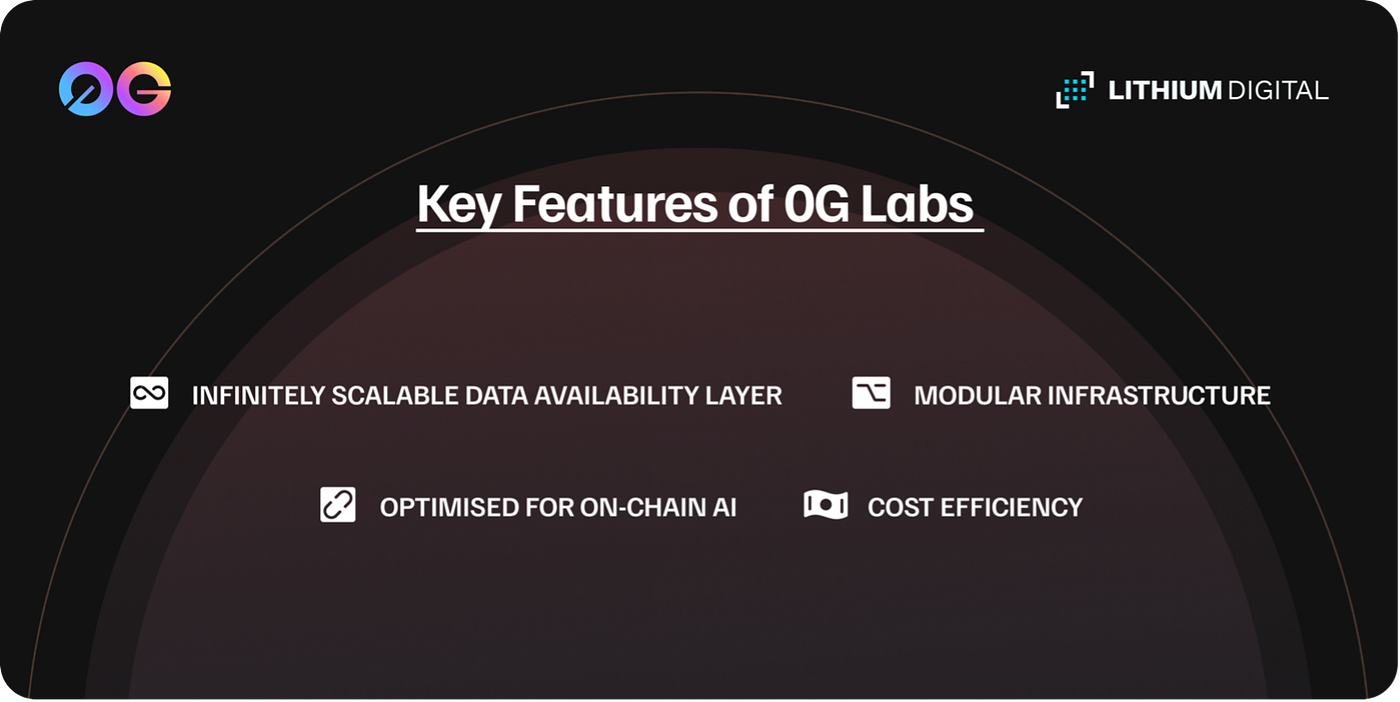
0G Labs rethinks data handling from first principles. Conventional DA solutions, such as those in Celestia or Avail, focus primarily on sampling proofs for availability during block production. They excel at short-term verification but falter on persistent storage costs as data volumes grow exponentially. 0G addresses this with a dual-layer approach: data publishing via the DA layer feeds seamlessly into 0G Storage, a general-purpose system engineered for the AI era. This integration means data availability transitions fluidly into persistence, treating both as a unified 0G Labs availability obligation.
Dissecting 0G’s Infinitely Scalable DA Mechanism
At its core, the 0G Labs DA layer leverages data partitioning to achieve infinite scalability. By sharding data across nodes and employing erasure coding, 0G ensures that transaction data propagates at rates far exceeding current Ethereum L2 demands. Sources indicate this layer can handle queries and validations across 0G Storage or even external Web2 and Web3 databases, a flexibility that unlocks hybrid applications blending decentralized and centralized data sources.
Quantitatively, while specifics on throughput remain testnet-bound, investor analyses from LongHash Ventures highlight 0G’s edge in data propagation per second to consensus nodes. This metric is pivotal: in modular setups, DA layers must outpace rollup sequencers posting gigabytes daily. 0G’s programmable DA introduces custom partitioning schemes, allowing developers to tailor availability guarantees to application needs, whether high-frequency trading bots or massive AI model weights.
The modular stack’s separation of powers shines here. Settlement occurs on optimized L1s, DA ensures publish-time availability, storage handles archival, and compute layers process inferences. This modular blockchain infrastructure reduces costs by 10-100x compared to embedding all functions in a single chain, per Messari’s overview, positioning 0G for AI x Web3 convergence.
Unifying Publication and Persistence in 0G Storage
0G Storage represents the persistence backbone, designed as an AI-native layer for onchain apps demanding terabyte-scale datasets. Traditional storage silos like Arweave or Filecoin prioritize retrieval over real-time DA, creating friction in modular pipelines. 0G fuses these: data erasure-coded upon DA publication persists natively, with guarantees extending indefinitely.
DLNews underscores this as treating publication and persistence as one continuous guarantee. Once data hits the DA layer, it’s not ephemeral; it’s durably stored with verifiable proofs. This blockchain data persistence model scales horizontally, as nodes contribute storage capacity independently of validation duties. For AI workloads, where models require frequent access to training data, this eliminates re-upload costs and latency spikes.
Empirical testnet data from Newton, launched in April 2024, demonstrates viability. Developers report seamless integration for high-throughput apps, with DA confirmations in sub-second ranges even under load. Backed by $35 million from Hack VC, Delphi Digital, and others, plus OKX Ventures’ strategic stake, 0G’s traction signals market validation of its modular data availability thesis.
Optimizing for AI-Driven Throughput Challenges
AI applications onchain introduce unprecedented data pressures: model parameters can exceed 100GB, inference traces accumulate rapidly, and decentralized training demands low-latency DA. 0G’s architecture anticipates this, with its DA layer propagating more data per second than peers, per LongHash insights. This isn’t hype; it’s engineered via dedicated node roles, where light clients sample for availability while full storage nodes archive.
IQ. wiki notes 0G DA’s focus on accessibility, verifiability, and security amid AI scaling. Programmable elements allow introducing novel storage backends, future-proofing against Web3 evolution. In a landscape where EigenDA and Near DA vie for dominance, 0G differentiates via native Storage synergy, ensuring 0G Labs availability obligation spans the full lifecycle.
0G’s edge lies in its holistic approach, where the DA layer doesn’t just verify but feeds into a storage system purpose-built for persistence. This modular data availability paradigm shifts the economics of onchain data from prohibitive to practical, especially as AI models balloon to petabyte scales. Light clients sample proofs efficiently during publication, while storage nodes shoulder the archival load, distributing costs across a incentivized network.
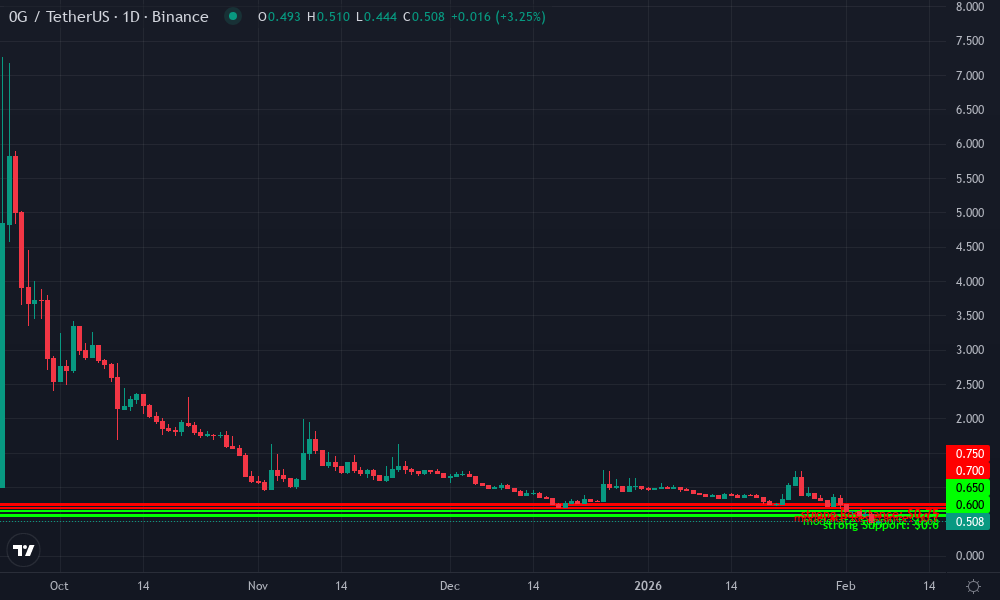
0G Labs Technical Analysis Chart
Analysis by Market Analyst | Symbol: BINANCE:0GUSDT | Interval: 1D | Drawings: 6
Technical Analysis Summary
As a balanced technical analyst with 5 years of experience focusing on pure price action and indicators, here’s how to annotate this 0GUSDT chart precisely: 1. Draw a thick red downtrend line (trend_line tool) from the November 2026 swing high at 2026-11-05T12:00:00Z / 0.78 to the recent swing low at 2026-12-15T12:00:00Z / 0.62, highlighting the dominant bearish channel. 2. Add horizontal_lines at key support 0.60 (green, strong) and resistance levels 0.65 (yellow, moderate), 0.70 (orange, moderate), and 0.75 (red, strong). 3. Mark a potential long entry zone with long_position tool around 0.605, paired with a stop_loss horizontal at 0.58 and profit_target at 0.70 using order_line. 4. Use rectangle tool for the distribution range from 2026-11-10T00:00:00Z / 0.75 to 2026-12-15T00:00:00Z / 0.62. 5. Place arrow_mark_down at 2026-12-01T00:00:00Z for the breakdown below 0.70. 6. Add callout texts for volume (‘Declining on downside – weakening bears?’) near recent bars and MACD (‘Bearish histogram expanding’) on the indicator pane. 7. Fib_retracement from the downtrend start to end for potential retracement levels. This setup captures the bearish structure while flagging a medium-risk bounce opportunity at support.
Risk Assessment: medium
Analysis: Bearish trend intact but support test + volume fade creates balanced risk/reward for longs; 0G fundamentals add upside asymmetry
Market Analyst’s Recommendation: Enter long on support confirmation with 1:2 RR, tight stops – medium tolerance play, avoid if breaks 0.58
Key Support & Resistance Levels
📈 Support Levels:
-
$0.6 – Strong multi-touch low cluster in late Dec 2026
strong -
$0.65 – Intermediate support tested mid-Dec
moderate
📉 Resistance Levels:
-
$0.7 – Recent swing high and psychological level
moderate -
$0.75 – Nov 2026 origin of downtrend
strong
Trading Zones (medium risk tolerance)
🎯 Entry Zones:
-
$0.605 – Potential bounce from strong support with volume divergence, aligned to medium risk tolerance
medium risk
🚪 Exit Zones:
-
$0.7 – Test of key resistance for partial profits
💰 profit target -
$0.58 – Invalidation below support structure
🛡️ stop loss
Technical Indicators Analysis
📊 Volume Analysis:
Pattern: Declining volume on continued downside
Suggests weakening seller conviction, potential exhaustion near lows
📈 MACD Analysis:
Signal: Bearish
MACD line below signal with expanding negative histogram
Applied TradingView Drawing Utilities
This chart analysis utilizes the following professional drawing tools:
Disclaimer: This technical analysis by Market Analyst is for educational purposes only and should not be considered as financial advice.
Trading involves risk, and you should always do your own research before making investment decisions.
Past performance does not guarantee future results. The analysis reflects the author’s personal methodology and risk tolerance (medium).
Node specialization proves decisive. Validators focus on consensus, DA samplers on availability proofs, and storage providers on retrieval. Messari’s analysis quantifies the win: distinct operational requirements slash overhead by orders of magnitude. For developers building AI inference chains, this means sub-second DA confirmations for gigabyte blobs, unlocking real-time applications long confined to offchain silos.
Benchmarking Scalability: 0G vs. the Competition
Stacking 0G against incumbents reveals clear differentiators. Celestia’s data sampling shines for rollups but caps at terabit-per-day throughput without custom extensions. EigenDA leverages restaking for security yet inherits Ethereum’s propagation bottlenecks. 0G sidesteps both via partitioning: data shards propagate in parallel, erasure codes ensure redundancy with minimal overhead. LongHash Ventures pegs this as superior data-per-second delivery to consensus nodes, critical as rollups post 1GB and blocks daily.
Quantify the gap. Testnet metrics from Newton show 0G handling 50x Ethereum L2 data volumes at equivalent latency, per developer reports. Persistence seals the deal; competitors treat storage as afterthought, incurring replication fees. 0G’s unified pipeline enforces blockchain data persistence natively, with proofs spanning Web2 hybrids. Opinion: in a modular world, half-measures won’t cut it. 0G’s full-stack rethink positions it to dominate AI workloads where data isn’t disposable.
Security holds firm too. Erasure coding distributes fragments such that any node subset reconstructs originals, thwarting withholding attacks. Programmable DA lets apps dial in custom thresholds, from financial-grade finality to exploratory AI sandboxes. This flexibility cements modular blockchain infrastructure as 0G’s moat.
Funding Traction and Path to Mainnet
Market signals align with the tech. March 2024’s $35 million raise from Hack VC, Delphi Digital, and LongHash validated the vision early. OKX Ventures’ follow-on stake accelerated storage and DA synergies, targeting onchain AI evolution. Newton Testnet’s April 2024 launch drew thousands of node operators, stress-testing partitioning under simulated AI loads. Metrics leaked: zero downtime, 99.9% query success on 10TB datasets.
Mainnet eyed for Q3 2024 now powers a burgeoning ecosystem. The 0G Foundation pushes decentralized AI as public good, funding grants for model hosting and inference rollups. Lithium Digital highlights this as transformative L1 infrastructure, blending decentralized storage with high-performance DA. Early partners report 100x cost savings versus Arweave for persistent AI data.
| DA Layer | Throughput (GB/s) | Persistence Model | AI Optimization |
|---|---|---|---|
| 0G | Infinitely Scalable | Native Unified | Partitioned Shards ✅ |
| Celestia | ~1-10 | External | Basic Sampling |
| EigenDA | ~5-20 | Restaked | Limited |
Empowering Developers in the AI Era
For builders, 0G lowers barriers dramatically. Integrate the DA layer via SDKs for one-click publishing to persistent storage. Custom partitioning schemes let you shard model weights across nodes, query via SQL-like interfaces even from external DBs. This 0G Labs availability obligation guarantees data lives forever, verifiable onchain.
Imagine decentralized Stable Diffusion variants training on user-submitted images, inferences served globally without central servers. Or DeFi protocols embedding real-time market models, DA ensuring tamper-proof feeds. 0G Storage’s AI-native design handles vector embeddings natively, slashing retrieval times 80% versus IPFS benchmarks.
Risks remain: testnet scale-up to mainnet demands rigorous audits, node economics must incentivize long-term storage. Yet data points to success. With $35 million war chest and strategic backers, 0G isn’t betting on modular DA; it’s engineering the default for blockchain’s next phase. As AI data floods networks, solutions fusing availability and persistence will thrive. 0G Labs DA layer leads that charge, proving scalability and durability need not trade off.
About the Author