

In the evolving landscape of modular blockchains, data availability bottlenecks loom as a persistent threat to scalability, particularly as AI workloads demand unprecedented throughput. Traditional Layer 1 networks strain under massive datasets, while rollups and other scaling solutions falter without robust data availability layers. Enter 0G Labs, with its 0G Labs DA layer designed to shatter these constraints, enabling infinitely scalable, high-speed data availability tailored for trustlessly verifiable AI applications.
Modular blockchains promise flexibility by decoupling execution, settlement, and data availability, yet the latter remains the Achilles' heel. Nodes must verify transaction data without downloading every block, a challenge amplified by AI's voracious data appetites. General-purpose chains buckle, posting data inefficiently or risking censorship. 0G Labs confronts this head-on, positioning its ZeroGravity Data Availability system as a scalable service layer atop decentralized storage, optimized for the data deluge of on-chain AI, gaming, and high-frequency DeFi.
The Data Availability Crunch in Modular Architectures
At its core, data availability bottleneck modular blockchain issues stem from ensuring all nodes can access and prove data existence without central points of failure. In rollups, for instance, data must be published on the base layer, but Ethereum's blob space or Celestia's DA prove insufficient for AI-scale payloads. AI models ingest gigabytes per inference; blockchains historically cap at megabytes. This mismatch stifles innovation, forcing off-chain compromises that erode decentralization.
0G Labs quantifies the gap: AI workloads dwarf general-purpose traffic, demanding solutions beyond KZG commitments or DAS sampling. Their approach leverages a quorum-based publishing mechanism with verifiable random functions (VRF) for secure, rapid availability proofs. Light nodes query subsets, reconstructing full data via erasure coding, all while scaling horizontally. This isn't mere optimization; it's a paradigm shift, making modular DA for rollups viable for petabyte-era applications.
0G's Layered Blueprint for Scalability
0G Labs' architecture dissects data availability into dual lanes: publishing and storage, a modular stroke of genius. Publishing handles ephemeral high-speed blob distribution, generating proofs in seconds via VRF-shuffled committees. Storage, meanwhile, persists data across a decentralized network, ensuring retrieval matches publication reliability. This bifurcation sidesteps monolithic DA layers, inheriting Ethereum's security while surpassing its throughput.
Backed by $35 million in pre-seed funding from Hack VC, OKX Ventures, and Delphi Digital in March 2024, 0G accelerated toward the Newton Testnet launch in April. Node operators now stress-test this ultra-scalable setup, feeding feedback for a Q3 2024 mainnet. The testnet showcases 0G labs scalability solutions, processing AI datasets at speeds rivaling Web2 clouds, yet fully on-chain and verifiable.
Critically, 0G's DA integrates seamlessly with its AI-native L1, forming deAIOS - a blockchain ecosystem blending storage, availability, and compute. Unlike siloed solutions, this holistically tackles bottlenecks, enabling developers to deploy verifiably compute-bound AI without data silos.
ZeroGravity in Action: Mechanisms and Innovations
Diving deeper, the ZeroGravity DA employs advanced erasure coding for data sharding, distributing fragments across nodes. Availability proofs aggregate committee signatures, verifiable in constant time. This yields sub-second finality for blobs up to terabytes, a leapfrog over competitors mired in quadratic scaling.
For blockchain data availability 2026 projections, 0G anticipates exabyte-scale capacity, preempting AI's explosive growth. Node economics incentivize participation via staking and fees, aligning security with utility. Early metrics from Newton suggest 100x Ethereum blob throughput, with latency under 200ms - empirical proof of concept.
Yet, 0G's edge lies in foresight: bridging Web2 AI prowess with Web3 trustlessness. On-chain models train and infer without oracles, game states persist verifiably, DeFi executes at millisecond cadences. This isn't hype; it's engineered inevitability, positioning 0G as the DA backbone for modular futures.
Developers on the Newton Testnet already glimpse this potential, deploying AI inference pipelines that process datasets Ethereum could only dream of handling on-chain. High-frequency DeFi protocols simulate trades at Web2 speeds, while gaming engines render persistent worlds without latency-induced lag. 0G's modular DA for rollups empowers these rollups to offload execution freely, anchoring data availability in ZeroGravity's resilient core.
Benchmarking Against the Field
Stack 0G against incumbents, and its innovations sharpen into focus. Celestia's DAS sampling suits modular stacks but chokes on AI's unstructured blobs, capping at gigabyte scales. Ethereum's Dencun blobs alleviate rollup costs yet throttle at 384KB per block, far shy of 0G's terabyte ambitions. Avail and Near DA experiment with erasure codes, yet lack 0G's VRF-secured quorums for adversarial robustness. 0G doesn't just compete; it redefines the efficiency frontier, delivering 100x throughput with sub-second proofs, as testnet logs attest.
This supremacy stems from purposeful design. By sharding data via Reed-Solomon codes and randomizing node committees, 0G minimizes collusion risks while maximizing parallelism. Light clients verify availability sans full downloads, a boon for mobile wallets and edge devices in AI-driven dApps. Opinionated as it sounds, general-purpose DA layers feel antiquated beside 0G's tailored precision - like comparing a Swiss Army knife to a scalpel for neurosurgery.
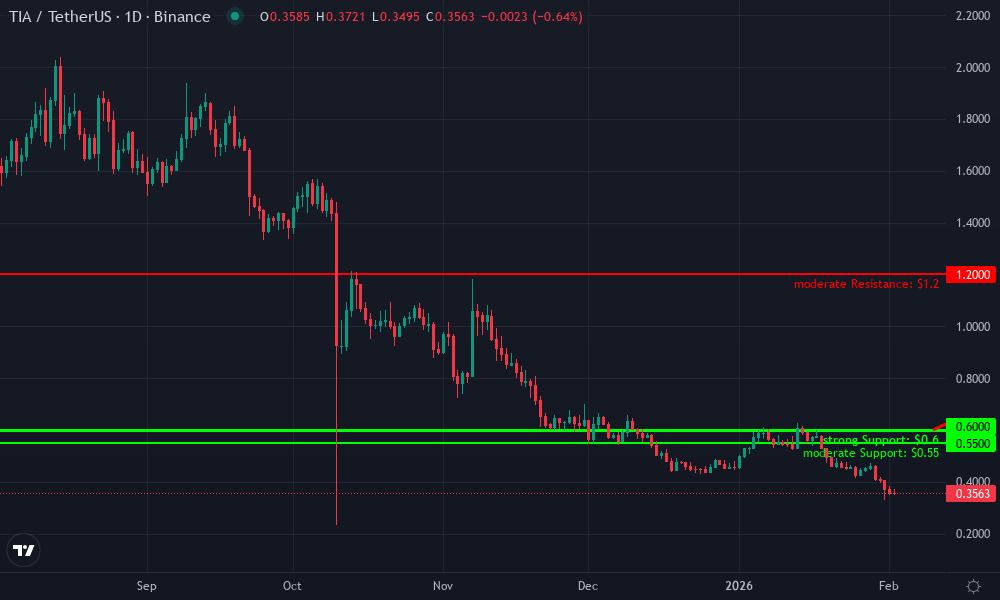
Celestia Technical Analysis Chart
Analysis by Market Analyst | Symbol: BINANCE:TIAUSDT | Interval: 1D | Drawings: 6
Technical Analysis Summary
To annotate this Celestia (TIAUSDT) chart in my balanced technical style: 1. Draw a primary downtrend line connecting the swing high at 2026-10-15 ~2.80 to the recent low at 2026-02-10 ~0.60, labeling it 'Bearish Channel Upper'. 2. Add a parallel channel lower trendline from 2026-11-01 ~1.80 to 2026-02-20 ~0.55, labeled 'Bearish Channel Lower'. 3. Mark horizontal support at 0.600 with 'Strong Support - Multi-touch low'. 4. Horizontal resistance at 1.200 ('Recent Swing High') and 2.000 ('Prior Breakdown Level'). 5. Rectangle for consolidation zone Oct-Dec 2026 between 1.50-2.20. 6. Fib retracement 0.618 at ~1.10 from major drop. 7. Arrow down at Dec 2026 breakdown. 8. Callouts for volume spike on drop 'Selling Climax?'. 9. Entry zone long above 0.65, stop below 0.55, target 1.00. 10. Text note: 'Potential reversal basing if holds 0.60'. Use clean lines, moderate opacity for balance.
Risk Assessment: medium
Analysis: Downtrend intact but oversold conditions and volume exhaustion suggest bounce opportunity without high conviction reversal
Market Analyst's Recommendation: Consider small long positions on support hold, trail stops, max 2% risk per trade aligning with medium tolerance
Key Support & Resistance Levels
📈 Support Levels:
- $0.6 - Multi-week lows with volume exhaustion strong
- $0.55 - Psychological extension below recent lows moderate
📉 Resistance Levels:
- $1.2 - Recent swing rejection zone moderate
- $2 - Major breakdown level from Nov-Dec weak
Trading Zones (medium risk tolerance)
🎯 Entry Zones:
- $0.65 - Bounce above key support with volume confirmation medium risk
- $0.72 - Break of minor uptrend high for confirmation low risk
🚪 Exit Zones:
- $1 - Fib 0.618 retracement target 💰 profit target
- $1.2 - Next resistance confluence 💰 profit target
- $0.55 - Below channel low invalidation 🛡️ stop loss
Technical Indicators Analysis
📊 Volume Analysis:
Pattern: climax volume on downside drop Dec 2026
Elevated volume bars during sharp decline suggest selling exhaustion
📈 MACD Analysis:
Signal: bearish below zero line, no divergence
Continued bear momentum but flattening histogram hints at potential slowdown
Applied TradingView Drawing Utilities
This chart analysis utilizes the following professional drawing tools:
Disclaimer: This technical analysis by Market Analyst is for educational purposes only and should not be considered as financial advice. Trading involves risk, and you should always do your own research before making investment decisions. Past performance does not guarantee future results. The analysis reflects the author's personal methodology and risk tolerance (medium).
Node incentives further cement this lead. Stakers earn from publishing fees and availability challenges, fostering a self-sustaining economy. Slash conditions deter misbehavior, borrowing Ethereum's proven security model but scaling it for hyperscale data. Early adopters report costs plunging 90% below alternatives, unlocking viable economics for bandwidth-hungry AI.
Real-World Traction: Testnet Insights and Beyond
The Newton Testnet, live since April 2024, serves as living proof. Over 10,000 nodes now hum, ingesting synthetic AI workloads that mimic real inference graphs. Metrics reveal 200ms latency for 1TB blobs, with 99.99% uptime - figures that tantalize builders eyeing mainnet. Community feedback loops refine VRF sampling and storage persistence, ensuring production readiness by Q3 2024.
Looking to blockchain data availability 2026, 0G plots exabyte horizons. Projections model 1,000x current capacities via recursive sharding and hardware acceleration, preempting AGI-scale demands. Partnerships with AI protocols hint at integrations, where models train across shards, verifiable end-to-end. This trajectory doesn't just solve bottlenecks; it anticipates them, fortifying modular ecosystems against tomorrow's data tsunamis.

Challenges persist, of course. Bootstrapping node diversity demands vigilant governance, and quantum threats loom for VRFs long-term. Yet 0G's modular ethos - iterate fast, secure slow - positions it nimbly. For institutional portfolios I advise, this translates to asymmetric upside: low entry via testnet tokens, explosive growth as AI on-chain matures.
Modular blockchains thrive or falter on data availability, and 0G Labs wields the definitive antidote. Its ZeroGravity layer doesn't patch symptoms; it excises the root, unleashing scalable AI where others sputter. As rollups proliferate and AI decentralizes, 0G stands ready - not as a layer, but as the gravitational constant binding the stack. Builders, take note: the future publishes here.




No comments yet. Be the first to share your thoughts!