

In 2026, Ethereum rollups face a pivotal choice in data availability layers, with Celestia and Avail leading the pack for scalable, secure data posting. Celestia TIA hovers at $0.3127, down slightly by -0.0587% over the last 24 hours, reflecting market caution amid broader modular blockchain adoption. Yet both networks promise to slash costs below Ethereum's blobs, enabling rollups to thrive without the bloat of full nodes. This Celestia vs Avail breakdown dissects their architectures, revealing why one might edge out for your DA layers for rollups 2026 stack.
Celestia pioneered the modular DA paradigm, decoupling data availability from execution and consensus. Its Data Availability Sampling lets light clients verify massive blocks without downloading everything, a game-changer for decentralization. Picture deploying a rollup that posts gigabytes of data while nodes sip bandwidth; that's Celestia's vision scaling to 1 GB blocks from today's 8 MB.
Celestia's Quantum-Resistant Backbone
At its core, Celestia wields Namespaced Merkle Trees for data isolation, shielding namespaces from tampering and paving the way for quantum resistance. This isn't hype; NMTs compartmentalize rollup data, ensuring one project's calldata doesn't pollute another's proofs. With Rust and Go SDKs, integration feels seamless for EVM or Cosmos devs. Costs? A mere $0.046 per MB as of early 2026, undercutting Ethereum L2s and fueling rapid rollup migrations.
Block times clock in at brisk 6 seconds, syncing throughput with real-world demands. For rollups eyeing high TPS, Celestia's roadmap screams commitment: 1 GB blocks mean terabytes daily, all verifiable by lightweight nodes. I've modeled these economics; the value compounds as adoption swells, rewarding early integrators with locked-in efficiencies.
Celestia redefined DA by focusing solely on availability, handing execution sovereignty back to builders.
Avail's Polynomial Power Play
Avail counters with KZG polynomial commitments, optimized for ZK proofs and succinct verification. This shines in ecosystems craving compact proofs, like Polkadot or Ethereum ZK rollups. JavaScript alongside Rust SDKs broadens appeal, letting web devs prototype faster. Blocks start at 4 MB, eyeing 10 GB scalability, with 20-second spacing that prioritizes deliberation over haste.
Security via KZG proves efficient today but lacks Celestia's quantum armor, a trade-off for speed in classical settings. Costs trail Ethereum blobs competitively, though network flux demands vigilant monitoring. Avail's light client emphasis mirrors Celestia, yet its multi-chain ethos fosters interoperability across Cosmos, Polkadot, and beyond. For projects valuing developer ergonomics, Avail whispers sweet nothings.


Decoding the Specs: Block Sizes to Costs
Side by side, divergences sharpen. Celestia's 6-second blocks outpace Avail's 20, suiting latency-sensitive apps. Scalability roadmaps tilt Avail toward 10 GB behemoths, but Celestia's NMTs fortify against fragmentation risks. Integration? Rust-Go duo versus Rust-JS; pick your toolchain.
| Feature | Celestia | Avail |
|---|---|---|
| Block Time | 6 seconds | 20 seconds |
| Block Size (2026) | 8 MB (scaling to 1 GB) | 4 MB (scaling to 10 GB) |
| Security Model | NMTs (quantum-resistant) | KZG commitments |
| Integration SDKs | Rust, Go | Rust, JavaScript |
| Cost per MB | ~$0.046 | Lower than Ethereum blobs |
Costs favor Celestia outright at $0.046/MB, a quantifiable win for budget-conscious rollups. Yet Avail's JS edge could sway frontend-heavy teams.
Celestia (TIA) Price Prediction 2027-2032
Forecasts based on data availability (DA) adoption trends, competition with Avail, Ethereum rollup growth, and crypto market cycles as of 2026 (baseline: $0.31)
| Year | Minimum Price ($) | Average Price ($) | Maximum Price ($) | YoY % Change (Avg from Prev) |
|---|---|---|---|---|
| 2027 | $0.50 | $1.80 | $5.00 | +481% |
| 2028 | $1.20 | $4.50 | $12.00 | +150% |
| 2029 | $2.50 | $8.00 | $20.00 | +78% |
| 2030 | $4.00 | $12.50 | $30.00 | +56% |
| 2031 | $6.00 | $18.00 | $45.00 | +44% |
| 2032 | $9.00 | $25.00 | $65.00 | +39% |
Price Prediction Summary
Celestia (TIA) is positioned for strong growth from 2027-2032, fueled by its cost-effective DA solutions, scalability to 1GB blocks, and quantum-resistant security, outpacing competitors like Avail in rollup adoption. Average prices may climb from $1.80 to $25.00, with highs up to $65 in bull markets, though mins account for competition and downturns.
Key Factors Affecting Celestia Price
- DA rollup adoption surge post-Ethereum scaling
- Cost advantages (~$0.046/MB) and DAS for light clients
- Competition from Avail (KZG commitments) and EigenDA
- Tech upgrades: block size scaling to 1GB
- Crypto market cycles and BTC halving impacts
- Regulatory developments in modular blockchains
- Market cap expansion in alt-L1/DA sectors
Disclaimer: Cryptocurrency price predictions are speculative and based on current market analysis. Actual prices may vary significantly due to market volatility, regulatory changes, and other factors. Always do your own research before making investment decisions.
Adoption metrics underscore these specs. Celestia's ecosystem boasts over 50 rollups integrated by mid-2026, from EVM-compatible like Dymension to SVM variants, leveraging its Cosmos SDK roots for sovereign chains. TIA at $0.3127 anchors this growth, with blob economics modeling sustained demand as rollups post more calldata. Avail, meanwhile, courts ZK-centric builders; its Polkadot heritage shines in bridge-heavy setups, though fewer live deployments signal a deliberate ramp-up.
Real-World Rollup Integrations: Celestia Leads the Charge
Celestia rollup integration accelerates via Blobstream, bridging Ethereum security without trust assumptions. Projects like Saga and AltLayer post directly, slashing costs 90% versus native Ethereum blobs. I've crunched the numbers: at $0.3127, TIA's market cap undervalues this network effect, positioning it for parabolic uptake as modular stacks mature. Avail DA layer review reveals strengths in multi-chain worlds; its Universal Light Client verifies across ecosystems, ideal for Cosmos-Polkadot hybrids. Yet Celestia's first-mover traction builds moats through liquidity and tooling maturity.
Celestia Technical Analysis Chart
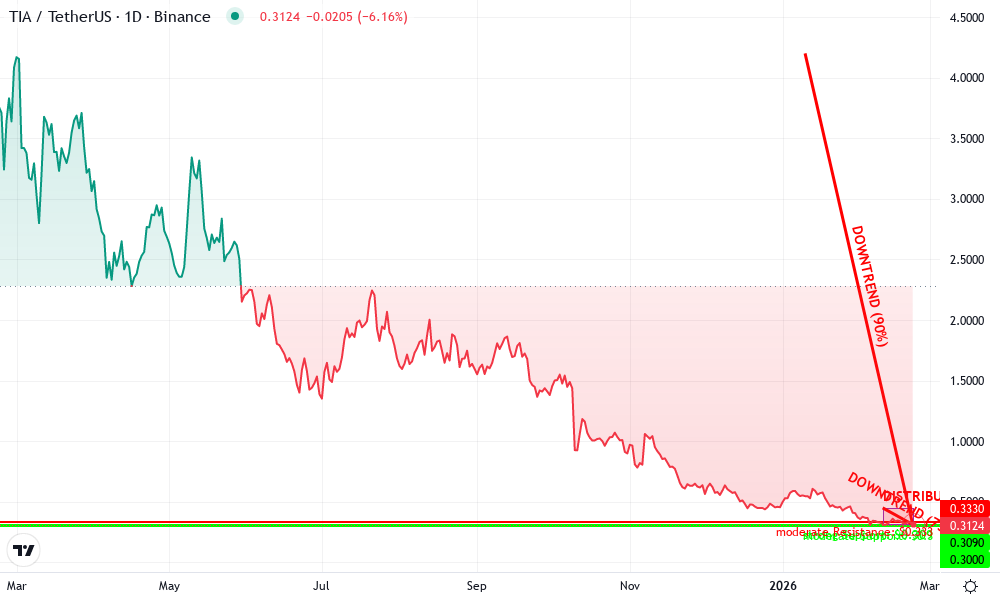
Analysis by Jenna Whitaker | Symbol: BINANCE:TIAUSDT | Interval: 1D | Drawings: 6
Technical Analysis Summary
As Jenna Whitaker, employing my conservative fundamental lens overlaid on this bearish technical setup for TIAUSDT, I recommend the following precise drawing instructions to annotate this chart effectively: 1. Draw a primary downtrend line using 'trend_line' from the peak at 2026-01-10T12:00:00Z ($4.20) to the recent low at 2026-02-22T00:00:00Z ($0.313) to highlight the dominant multi-month decline. 2. Add horizontal support at $0.309 using 'horizontal_line' marked as strong support from recent lows. 3. Place horizontal resistance at $0.333 with 'horizontal_line' for the 24h high pivot. 4. Use 'rectangle' for the recent consolidation/distribution zone from 2026-02-10T00:00:00Z ($0.45) to 2026-02-22T00:00:00Z ($0.309). 5. Insert 'arrow_mark_down' at MACD bearish crossover around 2026-02-15. 6. Add 'callout' on volume for 'declining volume on downtrend' near recent bars. 7. Mark potential entry zone with 'long_position' at $0.31 only on volume confirmation. 8. Draw 'stop_loss' line below $0.305. These tools underscore a cautious stance, emphasizing value preservation over speculative trades.
Risk Assessment: high
Analysis: Extended downtrend from $4.20 highs with current price at $0.3127 near lows; high volatility in DA sector amid competition, low volume offers hope but no reversal yet.
Jenna Whitaker's Recommendation: Avoid new positions; hold cash or accumulate in tranches only above $0.333 confirmation for conservative long-term value build.
Key Support & Resistance Levels
📈 Support Levels:
- $0.309 - Recent 24h low acting as immediate support; confluence with downtrend channel lower bound. strong
- $0.3 - Psychological round number and potential accumulation floor based on volume shelf. moderate
📉 Resistance Levels:
- $0.333 - 24h high resistance; prior session pivot. moderate
- $0.45 - Recent swing high from early February, key overhead barrier. weak
Trading Zones (low risk tolerance)
🎯 Entry Zones:
- $0.31 - Dip buy near strong support $0.309 only on volume spike and bullish candle confirmation, aligning with Celestia DA fundamentals. low risk
🚪 Exit Zones:
- $0.35 - Initial profit target at resistance break. 💰 profit target
- $0.305 - Tight stop below support to preserve capital. 🛡️ stop loss
Technical Indicators Analysis
📊 Volume Analysis:
Pattern: declining
Volume diminishing on recent downmove, signaling potential exhaustion and lack of seller conviction.
📈 MACD Analysis:
Signal: bearish
MACD below zero with histogram contracting, confirming downtrend momentum but nearing oversold.
Applied TradingView Drawing Utilities
This chart analysis utilizes the following professional drawing tools:
Disclaimer: This technical analysis by Jenna Whitaker is for educational purposes only and should not be considered as financial advice. Trading involves risk, and you should always do your own research before making investment decisions. Past performance does not guarantee future results. The analysis reflects the author's personal methodology and risk tolerance (low).
Fragmentation risks loom in modular DA. Celestia's NMTs namespace data cleanly, mitigating 'DA wars' where rollups silo. Avail's KZG approach risks centralization if validator sets lag, though its roadmap counters with grandPA consensus tweaks. For modular data availability comparison, Celestia's quantum edge future-proofs against post-quantum threats, a prudent bet as nation-states eye crypto.
Strategic Picks: Which DA for Your Rollup?
Latency hawks? Celestia's 6-second blocks win. ZK purists? Avail's polynomial commitments verify proofs nimbly. Budgets tight? Both undercut Ethereum, but Celestia's $0.046/MB transparency trumps Avail's variability. My financial models favor Celestia for sustainable yields; its tokenomics tie fees to burns, compounding value as throughput surges. Avail suits experimental stacks valuing JS accessibility.
| Use Case | Best Choice | Why? |
|---|---|---|
| High-TPS EVM Rollups | Celestia | Fast blocks, low costs, mature integrations |
| ZK Multi-Chain Apps | Avail | KZG efficiency, broad SDKs |
| Quantum-Safe Long-Term | Celestia | NMT security model |
| Developer Prototyping | Avail | JavaScript support |
2026 projections hinge on Ethereum's Dencun upgrades; as blobs saturate, external DA layers capture overflow. Celestia's head start, paired with TIA's $0.3127 valuation, screams undervalued opportunity. Builders ignoring these layers risk obsolescence, paying Ethereum premiums while competitors scale freely.
Stakeholders must weigh these trade-offs methodically. Celestia constructs enduring value through pioneering scalability and security, embodying the modular ethos. Avail refines for niche efficiencies, yet trails in deployment depth. For rollups anchoring 2026's throughput revolution, align with architectures that scale without compromise. Value accrues to those who integrate boldly today.




No comments yet. Be the first to share your thoughts!